Habitat — News
The Geometry of Condition
A hypothesis: the same observables that surface how someone reads also surface what their position allows them to see.
March 5, 2026
Habitat Scenario 001: Who Gets to Live in Ridgeview?
We published Scenario 001 earlier, yesterday to be precise. It produced three geometric profiles from three readers engaging with the same housing policy documents. The reading report surfaced their divergent orientations: the planner organized around what the data shows, the resident around what is owed, the developer around what the numbers require. The technical companion showed the pipeline: where each person's attention concentrated, how tightly, what was absent, and in what register.
That report described how three people read. This post asks a harder question: why they read that way, and whether the geometry already contains the answer.
I. Condition
When you read a document, you don't attend to everything equally. Some concerns pull harder. You spend more time there, build your understanding around them, and your reading organizes itself along certain axes. Habitat measures that organization. Where your attention is densest, the system registers compression: a high score on the dimensions where your reading energy concentrates. How tightly it concentrates is the pressure ratio. A narrow ratio means your attention has very little room to move. Where your attention doesn't go registers as dimensional absence: the parts of the problem your reading leaves untouched.
You are already doing this, reading this post. Some terms land and some don't. If "pressure ratio" made immediate sense, that reflects your training. If it didn't, that is not a deficit. It is a measure of which registers your experience has opened and which it hasn't. The words that stop you and the words that don't are not markers of intelligence. They are markers of access. That is condition. Not only the condition of a text, or a reading, or even what you can see. It is the condition of the negotiation surface between any two people trying to make sense of the same problem. It is a condition of deliberation itself.
The table below shows what these measurements look like for three people reading the same set of housing policy documents about a proposed Community Land Trust in Ridgeview.
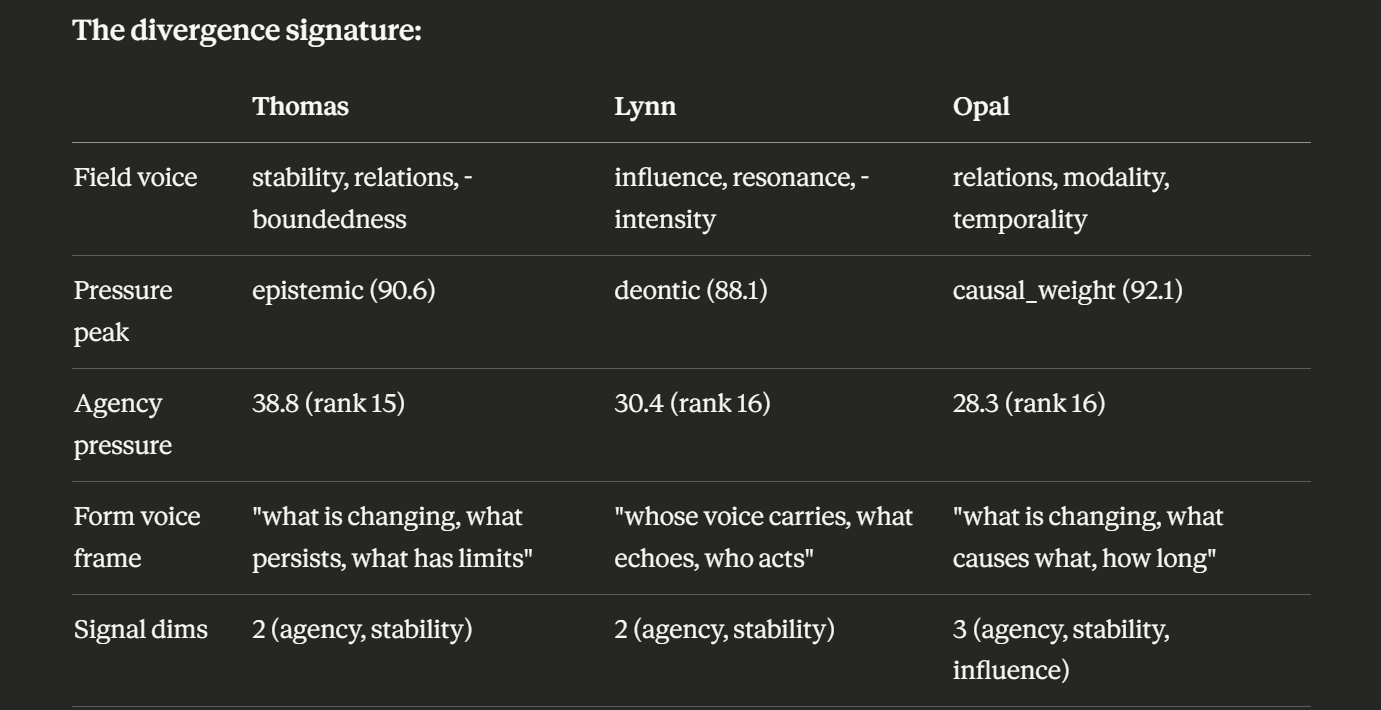 The divergence signature. Each row is a reader. The columns show where attention concentrates, how tightly, and in what register.
Thomas, a city planner, compresses around epistemic certainty: what the data shows, what the models predict, what the fiscal projections support. Opal, a developer, compresses around causal weight: what changed, what caused what, how the numbers constrain what gets built. Her pressure ratio of 3.25 is the tightest of the three. Her reading corridor is the narrowest. Lynn, a longtime resident, compresses around deontic obligation: what is owed, who is affected, what the community needs. Her highest-grip composition is a sentence with zero fiscal content: "My daughter is a dental hygienist."
The reading report treated these as orientations, different shapes of attention applied to the same problem. But the geometry is encoding something more specific than preference. It is encoding constraint.
The hypothesis
Where your attention concentrates is not a personality trait. It is a product of position. Where someone compresses, where they don't, and where their surplus concentrates are observables of structural condition: economic access, institutional role, register availability. Not cognitive style.
Three observations from the Ridgeview data support this:
1. Pressure ratio measures attentional constraint, and the source of that constraint is structural.
Opal's pressure ratio of 3.25 is not a personality trait. It is what capital does to cognition. The developer feasibility pro forma creates a corridor: 25% margin drops to 10.5% under the inclusionary overlay, most lenders require 15% for construction financing, the project likely doesn't get built. That corridor dictates her attentional geometry. She compresses tightly because the numbers leave no room not to. The pressure ratio is a direct observable of how narrow the viable reading space is. In Opal's case, the narrowness is produced by financial structure, not individual disposition.
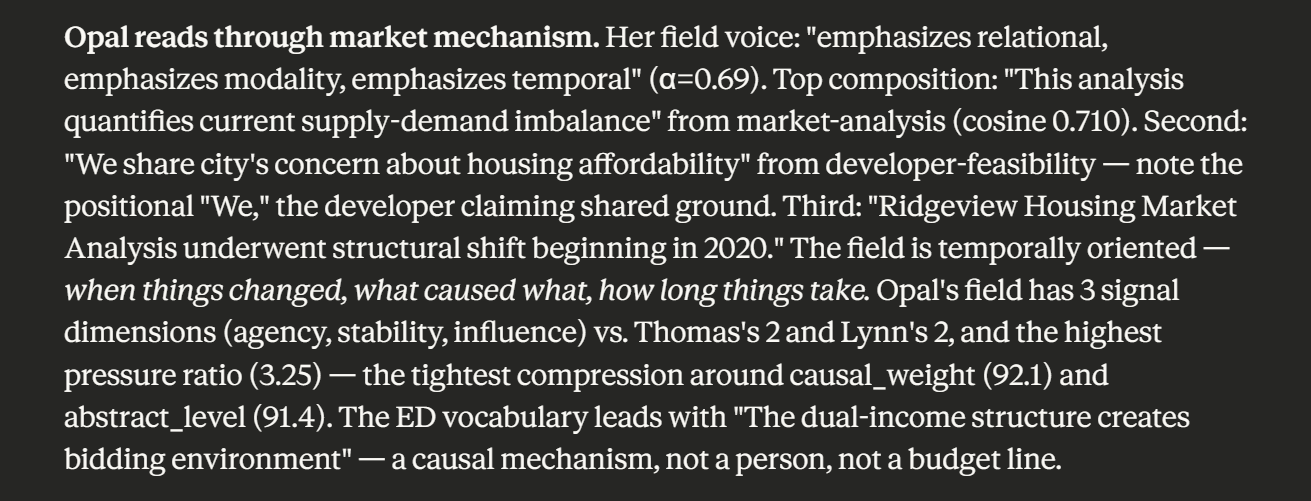 Opal's field. Pressure ratio 3.25, the tightest compression. Three signal dimensions. The field is temporally oriented: when things changed, what caused what, how long things take.
Thomas's pressure ratio is wider. He has institutional resources (fiscal models, comparable city data, revenue projections) that distribute his attention across a broader surface. The width of his field is an observable of institutional access.
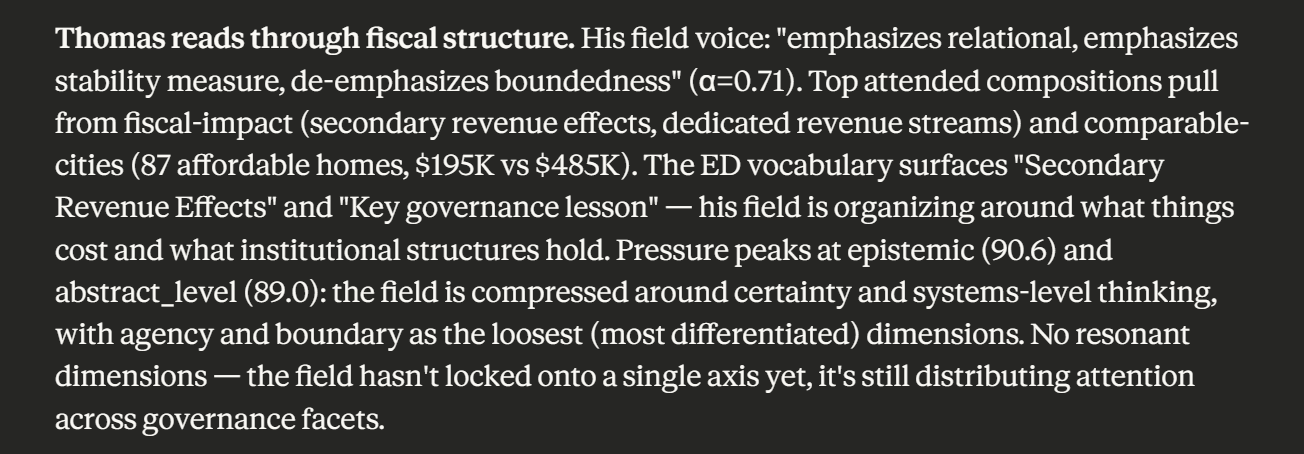 Thomas's field. Epistemic pressure at 90.6. No resonant dimensions; the field hasn't locked onto a single axis yet. His attention distributes across governance facets.
2. Surplus measures register inequality.
Lynn's top composition, "My daughter is a dental hygienist," carries enormous meaning in plain words. Habitat measures that gap as surplus: the distance between what the linguistic structure can hold and what the meaning requires. When someone's experience exceeds the vocabulary available to express it, surplus is high.
This is not sentiment. Lynn does not have access to fiscal modeling language, zoning terminology, or pro forma conventions. Her lived knowledge of displacement enters the field in a register that the compositional architecture was not built to privilege. The surplus measures that mismatch precisely. It shows where human reality exceeds the institutional grammar, and it shows who is forced to speak in registers the system was not designed to carry.
The developer's surplus is low. The planner's is moderate. The resident's is high. That gradient is not about eloquence. It is about whose language the institutional surface was built to carry.
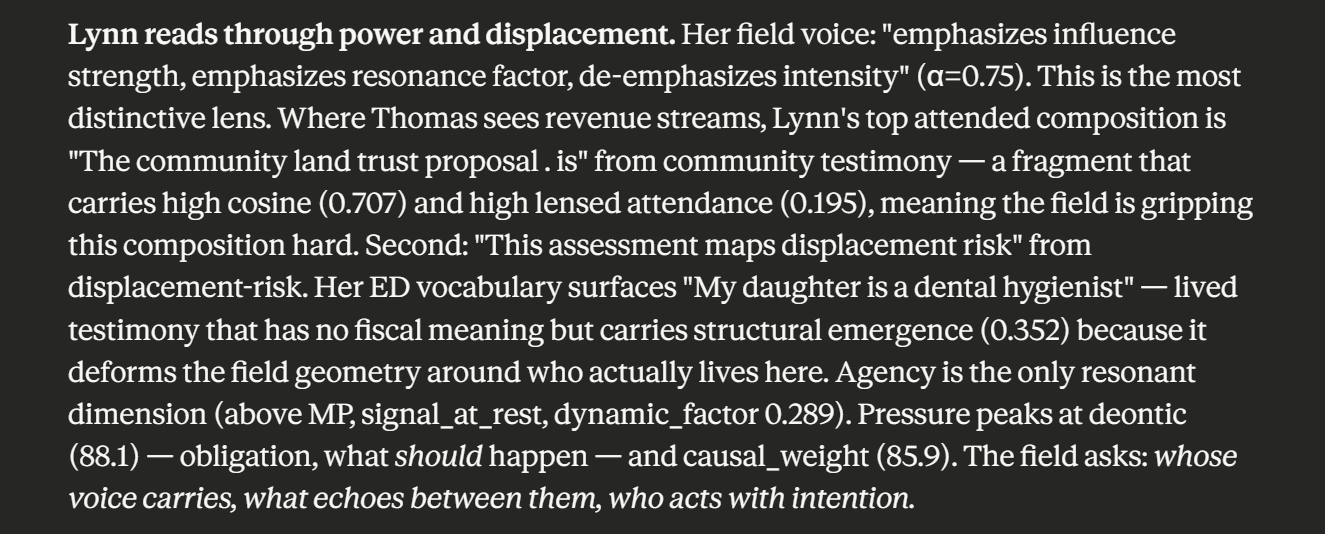 Lynn's field. Deontic pressure at 88.1. Agency is the only resonant dimension. "My daughter is a dental hygienist," the composition where lived testimony surfaces most strongly.
3. Dimensional absence maps structural exclusion.
Thomas backgrounds human reality. "Workforce retention" appears in his field as a fiscal line item. His deontic pressure is low. Not because he doesn't care, but because his institutional position does not require him to attend there. The geometry observes this as low compression in deontic dimensions: a measurable absence.
Lynn's epistemic compression is low. She does not have access to the data pipelines, modeling tools, or institutional vocabulary that would let her compress in that register. The dimensional absence is not ignorance. It is the geometric signature of what position does not afford.
These absences are at least as diagnostic as the pressure peaks. Where someone doesn't compress maps directly to what their structural conditions exclude from attention. Not by choice, but by access.
From observation to lens
These three observables (pressure ratio as constraint, surplus as register inequality, dimensional absence as structural exclusion) are already computed by the system. They require no new mathematics. The question is whether they can be operationalized as a lens: a repeatable, falsifiable frame that the geometry itself validates.
The method would work like this:
Take the geometric parsing as fixed ground truth. For a given structural condition (economic position, institutional role, proximity to displacement), state what the condition predicts about how attention distributes, where surplus concentrates, and how different users' fields align or diverge. Then test whether those predictions hold across instances.
If residents consistently produce high deontic pressure, high surplus, and low epistemic compression, not because they are a type but because displacement geometrically constrains attention in observable ways, then the lens is grounded. The sociology doesn't override the geometry. The geometry validates the sociology.
The cross-session field comparison is where this becomes most concrete. The system computes a matrix that maps how each user's compositional attention relates to their semantic attention across all dimensions. When Thomas and Opal's patterns align while Lynn's diverges, that alignment is itself an observable of structural affinity. Institutional actors and capital actors share geometric features that community actors do not. That convergence is not opinion. It is computable from the field geometry without labeling anyone.
The claim so far
Habitat's geometric observables (pressure, surplus, dimensional absence, cross-session field comparison) already encode structural condition. They do not merely describe how someone reads. They surface what economic position, institutional access, and cultural embeddedness do to the shape of attention. This is not metaphor. It is measurable in the field comparisons, the attention trajectories, and the surplus distributions the system already computes.
The hypothesis: lensing is a function of the geometry, not an interpretive overlay. The conditions that shape human attention leave geometric signatures. Those signatures are observable, comparable, and, if the predictions hold across sufficient instances, falsifiable.
But condition is only the first leg. An individual geometric profile tells you where someone stands. It does not tell you where people can meet.
II. The negotiation surface
Habitat organizes its observations into frames. Two of them matter here.
Read looks at one person at a time. Where do they compress? What's absent? What does their surplus look like? This is the individual geometric profile described in Part I. It is diagnostic of position.
See looks at the space between two people. It takes their individual fields and computes the relationship: where their attention overlaps, where it diverges, and where one person's vocabulary covers ground the other's doesn't. This is not a narrative comparison. It is a geometric one.
These are not two ways of looking at the same thing. They are two legs of a structure that produces a third surface between them.
Where fields overlap
When Thomas's field is compared to Lynn's, certain dimensions align and others diverge. Both attend to agency. But Thomas's attention to agency is about institutional capacity: can the CLT board maintain quorum? Lynn's is about community voice: will the tripartite board include people from the neighborhoods? The dimension aligns. The pressure within it diverges.
That is not a contradiction to resolve. It is the precise shape of the gap, and the precise shape of the shared ground beneath it.
The overlap region, where two or more people's attention shares structure, is computable from the field comparisons. The system identifies where shared attention is densest and where meaning exceeds the shared vocabulary. So it can locate not just that two fields overlap, but where the overlap has traction.
Traction and breakdown
The negotiation surface is not the midpoint between two positions. It is the region where both people are paying attention and where the available vocabulary is adequate to hold what both of them mean. This is where response (a policy adjustment, a reframing, an intervention) has geometric purchase. It would land in both fields simultaneously because both fields are already compressed there and the register is shared.
Where surplus is high on both sides, the geometry identifies something different: the zone where shared language breaks down. Where both readers are attending but neither has structural vocabulary adequate to what the meaning requires. Intervention in that zone needs to build new register before it can land. The surplus tells you this before anyone speaks.
Where surplus is high on one side and low on the other, the geometry surfaces register inequality directly. One party has the institutional grammar for this dimension. The other has the lived experience. The mismatch is not a matter of translation. It is observable as asymmetric surplus, and the asymmetry tells you which direction the register deficit runs.
Three layers from the same geometry
Read gives you individual condition: where someone compresses, what's absent, what their surplus reveals about register access.
See gives you the relational map: where fields align, where they diverge, how the comparison reveals structural affinity between users.
The overlap computation gives you actionable surface: where response has geometric purchase, where shared language holds, where it breaks down, and which direction the deficit runs.
These are not interpretive frames applied after the fact. They are computable from the field geometry and the surplus distributions the system already produces. The editorial claim, that structural position constrains not only individual attention but the possibilities for mutual legibility, becomes testable against the field data rather than asserted on top of it.
What this requires
Rigor. The Ridgeview scenario is three readers. Three readers can demonstrate divergence. They cannot distinguish structural regularity from individual variation. The hypothesis predicts that people in similar structural positions will produce similar geometric signatures: that displacement looks like something specific in the field comparison, that capital access looks like something specific in the pressure ratio, that institutional role looks like something specific in the dimensional absence pattern. And it predicts that the negotiation surfaces between structurally similar user-pairs will share geometric features that surfaces between dissimilar pairs will not.
Testing this requires multiple instances per condition. Five practitioners reading the same domain from different structural positions. The same structural position reading across different domains. Cross-condition, cross-domain observation at sufficient scale to separate signal from coincidence. And critically, cross-pair observation: enough user-pair comparisons to show that the negotiation surface is produced by structural relationship, not individual chemistry.
It also requires an ethos. A system that can observe structural constraint can also be used to flatten people into their conditions, to treat the geometry as deterministic rather than diagnostic. A system that can compute negotiation surfaces can also be used to engineer consensus rather than observe where genuine legibility exists. The lens must be held with the same discipline as the observation: it shows what position affords, not what a person is. It shows where mutual legibility is geometrically possible, not where agreement should be manufactured.
Lynn's deontic compression is not her identity. It is the geometric trace of what displacement makes urgent. The asymmetric surplus between her field and Thomas's is not a problem to solve. It is a diagnostic of whose register the institutional surface was built to carry. The system observes these structures. It does not flatten them.
What comes next
This post describes what the geometry encodes and how two frames, Read and See, produce an actionable surface between individual condition and relational topology.
But condition and negotiation are observations about practice. They are not yet observations of practice: how fields develop through time, how the negotiation surface shifts as users compose into it, how the geometry of attention changes as practitioners accumulate experience within and across domains.
That is the subject of the next post, where the developmental arc of the field itself becomes the observable.
Habitat is built by Curious Company. habitat.ooo
This post was conceived, composed and actively edited by a human.