Gems Are Visible
Curious · February 27, 2026
What Happened
The Gem Index shipped. Every Gem a user has crystallized — every frozen moment of practice — is now visible in a grid, colored by developmental state, expandable into its full geometric detail. Shareable as a Portable Knowledge Media URI.
This is not a dashboard for administrators. This is a personal collection. The user owns these. The user shares them by choice. The user sees exactly what the geometry produced.
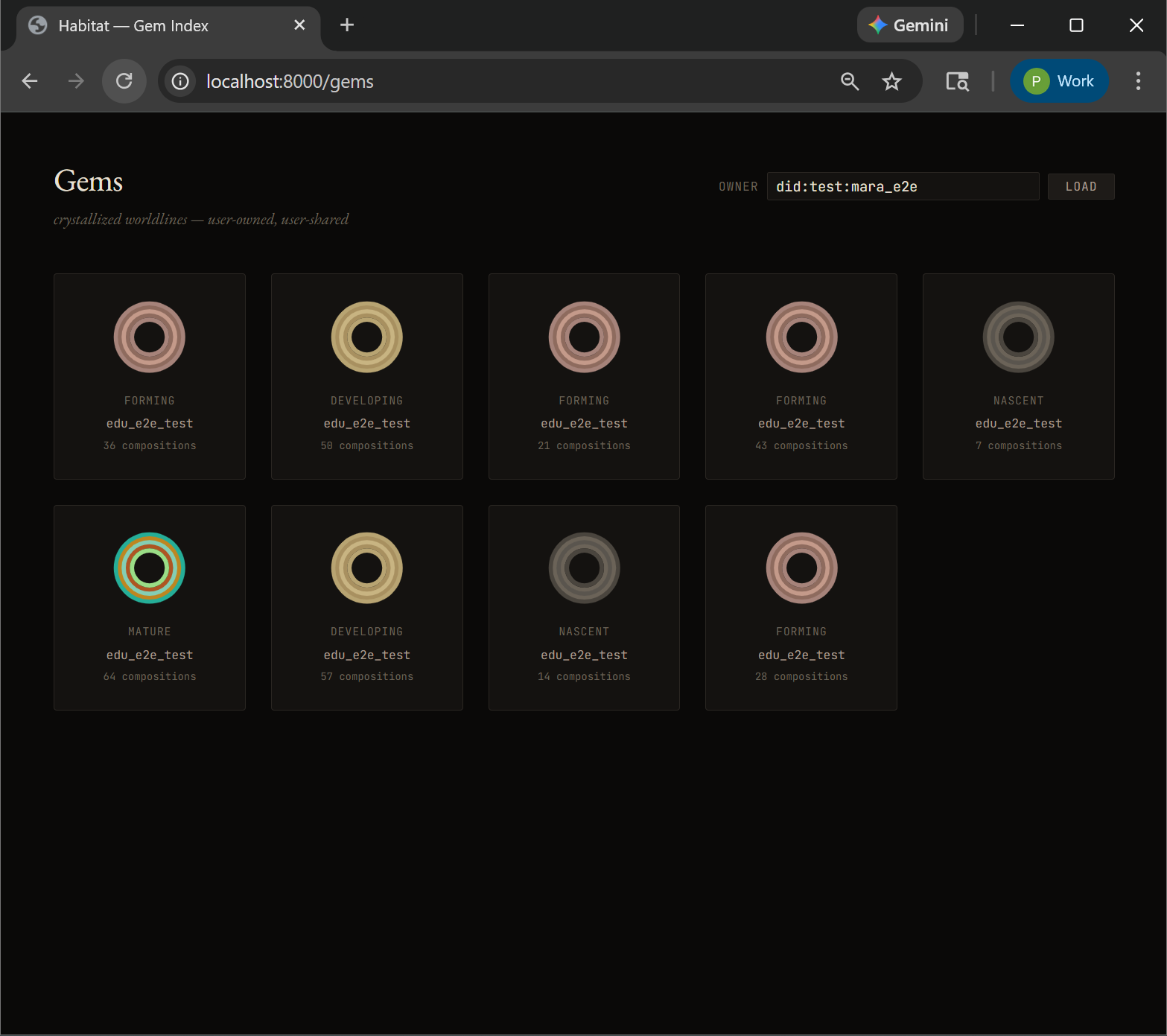
Nine Gems from a single user's practice. Each icon's rings shift color as the field develops — muted earth tones for nascent and forming sessions, warm amber for developing, vivid polychrome for mature. The grid is a collection, not a leaderboard. Every Gem is a frozen worldline.
What a Gem Contains
A Gem is not a summary. It is not a transcript. It is the complete geometric state of a session at the moment it was crystallized — the covariance matrix Σ frozen, the mean μ frozen, the trace memory of every composition that built the field, and the overlay surface snapshot that describes what the field looks like at that moment.
When you tap a Gem in the grid, it expands into its full geometry:
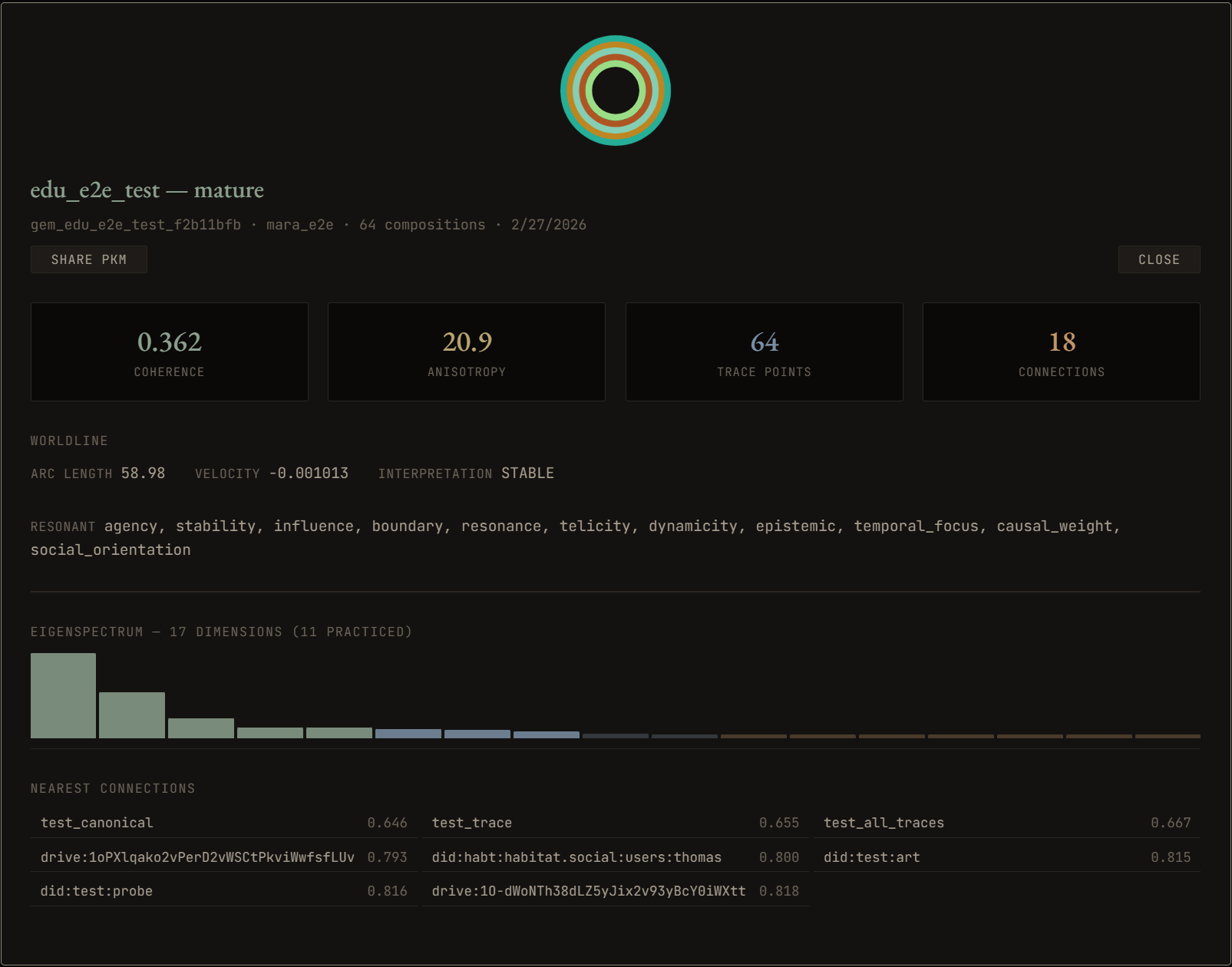
A mature Gem. 64 compositions. Coherence 0.362. Anisotropy 20.9. Eleven of seventeen dimensions are resonant — agency, stability, influence, boundary, resonance, telicity, dynamicity, epistemic, temporal focus, causal weight, social orientation. The eigenspectrum shows where practice concentrated (tall bars) and where dimensions remain sparse (short bars). The worldline — arc length 58.98, velocity −0.001, interpretation STABLE — tells you the field settled. It found its shape through practice and stopped moving.
What the Colors Mean
Each Gem icon has five concentric rings. Their colors shift based on the field's maturity — a direct mapping from the overlay surface classification described in The Overlay Surface Ships.
| Maturity | What It Means | Visual |
|---|---|---|
| Nascent | Fewer than ~10 compositions. The field hasn't differentiated yet. | Muted grays |
| Forming | Dimensions are beginning to separate from the noise floor. Signal is emerging. | Warm earth tones |
| Developing | Multiple dimensions carry signal. Eigenvalue trajectories show movement. | Amber and gold |
| Mature | The field has practiced dimensions, settled trajectories, and resonant structure. | Vivid polychrome — each ring a distinct hue |
The color is not assigned. It is observed. The maturity classification comes from the Marchenko-Pastur spectral threshold, the eventuality classifier, and the pressure map — three independent geometric readings that compose into a single developmental label.
What the Numbers Say
The expanded Gem shows four summary statistics drawn directly from the frozen geometry:
- Coherence (0.362) — the normalized trace of the precision matrix. How tightly the field's dimensions relate to each other. Higher coherence means more structured interdimensional relationships.
- Anisotropy (20.9) — the ratio of the largest to smallest eigenvalue of Σ. How directional the field is. An isotropic field (anisotropy ≈ 1) has uniform variance in every direction. Anisotropy of 20.9 means the field is twenty times more practiced in some dimensions than others.
- Trace Points (64) — each one a composition that entered the field and shifted the geometry. The worldline is the path through semantic spacetime that these 64 points trace.
- Connections (18) — other sessions, users, and documents that this Gem's geometry is coupled to. Distance is measured in the Gem's own metric. Closer connections share more geometric structure.
The worldline section shows arc length (58.98 — how far the field traveled in 17D space), velocity (−0.001 — the field has nearly stopped moving), and interpretation (STABLE — the velocity is below the dynamic noise floor). Eleven dimensions are resonant — they carry signal above the Marchenko-Pastur threshold.
The eigenspectrum is the per-dimension variance portrait: 17 bars, one per dimension. The first five (agency, stability, influence, boundary, resonance) are gradient dimensions from process-actor linguistics. The next five are aspectual dimensions. The final seven are extended process-assert dimensions. Tall bars are practiced. Short bars are sparse. The visual is a direct rendering of the diagonal of Σ.
Sharing: Portable Knowledge Media
Every expanded Gem has a Share PKM button. Pressing it copies a Portable Knowledge Media URI to the clipboard:
This URI is a semantic address. It identifies a specific frozen worldline — not a copy of it, but a pointer to the original geometric object. Anyone who receives the URI and has access can instantiate the Gem against their own field, producing a view that is warped by their geometry. Same Gem, different frame. The twin paradox of semantic spacetime.
PKM is the sharing mechanism for knowledge that has shape. A Gem URI carries enough information to locate the frozen geometry, verify provenance, and render the Gem in the recipient's own developmental context. It is not a link to a document. It is a coordinate in a geometric space.
The sharing semantics are described in Observable, Social Knowledge. Gems are portable between contexts. They go where the user goes.
What This Means
Until now, the geometry was observable through the API — typed endpoints returning numerical data. The overlay surface shipped as infrastructure. The precision matrix foundations were published. The theory was validated.
Now the geometry is visible. A user opens their collection and sees their practice — not as a list of things they did, but as a set of frozen developmental portraits, each one colored by how far the field developed, each one expandable into its full geometric detail.
The Gem grid is the first surface where Habitat's geometry meets a human eye without an intermediary. No agent interpreting. No summary compressing. The rings shift color because the eigenvalues crossed a threshold. The bars are tall because the variance accumulated in those dimensions. The worldline says STABLE because the velocity dropped below the noise floor.
The field produced these observations. The viewer sees them directly.
What's Next
Curation. A Gem grid is a collection. Collections need curatorial tools — selection, sequencing, annotation, publication. The infrastructure for user-controlled curation is next.
Publication. A curated collection of Gems becomes a portable portfolio of practice. Not credentials. Not transcripts. The actual geometry of what was practiced, in what order, with what developmental trajectory.
And instantiation — loading a Gem against the current field state to see how the frozen geometry looks from where you are now. The twin paradox rendered as a user experience.
Curious Company LLC · Habitat Foundation All rights reserved. Patent pending. Portable Knowledge Media: U.S. Patent Application 63/806,337