Habitat — News
Possible Knowledge
This isn't the most direct way to unveil 3 years of arduous work. Confusion. Poetics. Techie argot. But a lived experience of knowledge, sovereignty and accessibility is truly existential.
March 7, 2026
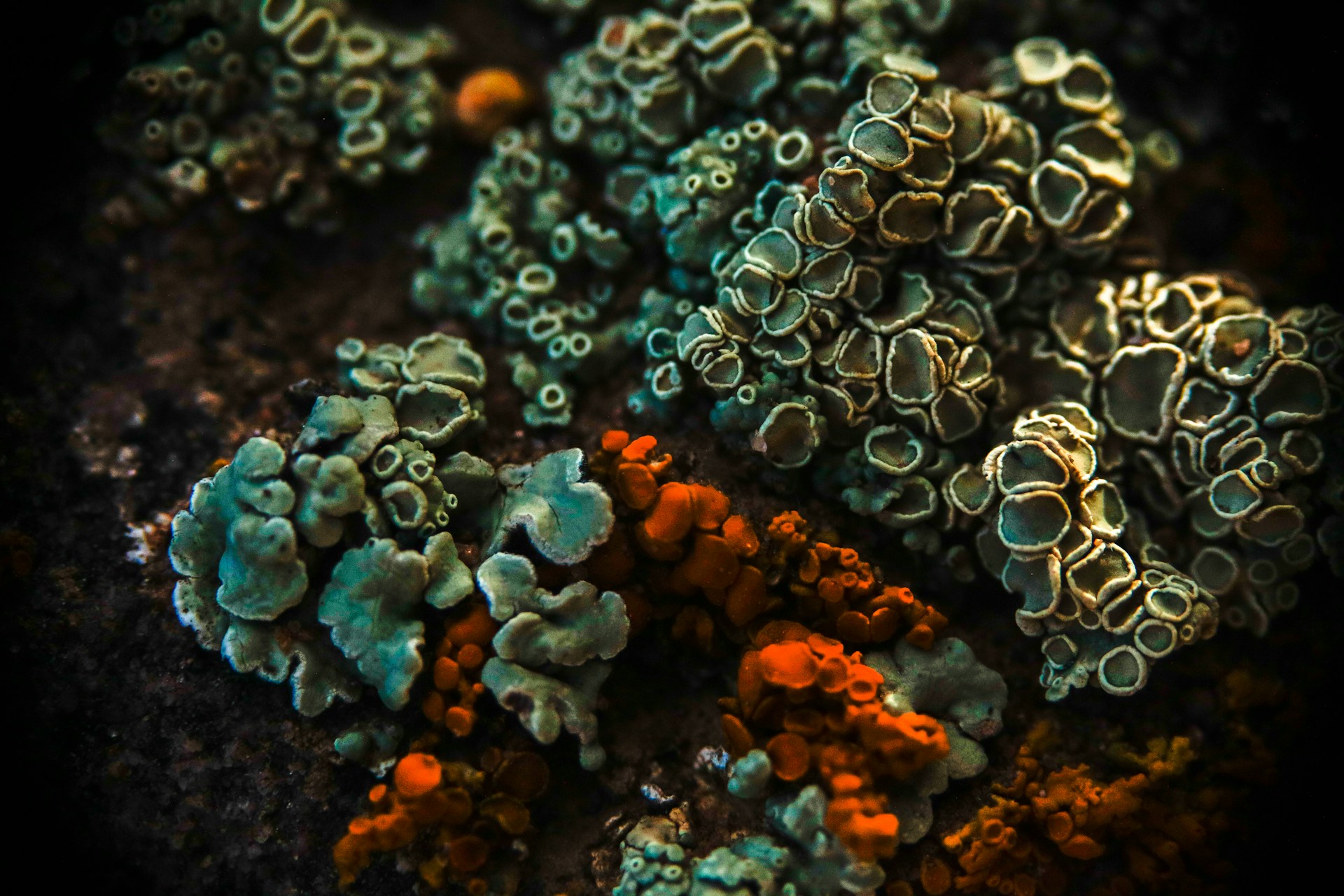
Corals have a "mutualistic relationship with microscopic algae called zooxanthellae." Photo by Patrick Hendry
Possible knowledge is, as far as I can see, relationships between sovereignty, curiosity and access. "My curiosity seeks" is a truly existential statement. It's not implicit or bestowed. It doesn't come from outside. It is a condition.
Curiosity
Not to rain on anyone's unmitigated revery, but curiosity is not really a personality trait. It is a shared structural condition. When curiosity sets down in the world a composition emerges. You've written, planted, built, spoken something. That's not curiosity. It is its imprint. In the human-built and more than human world we exist on this field. We make stuff along the traces of our own and other's curiosity.
To push this a little, curiosity is architectural. It 'composes' the state of a field that has accumulated enough to sense what it hasn't yet reached. As beings on this planet we ply this gap, the gap between curiosity and knowledge — dimensions (of words) approaching signal (measurable meaning) exceeding the vocabulary available to hold it (surplus) corridors opening toward knowledge that is geometrically (quite literally) available from where you stand — but hasn't been composed. Whew!
To make that a little more accessible, ever been to a town meeting? Often the debate unfolds or stalls in this gap between known and not composed. It's an often messy (insert whatever disingenuous, made up bs you can imagine here) meeting centered around curiosity, meaning and possible knowledge. These debates, in town meetings or social media, are materially composing our collective structure.
Every earnest practice produces this condition. Research, knitting, writing, teaching, organizational analysis, debate — none operate on knowns. They operate on what hasn't been composed yet. These are not guesses. They are, I assert, geometric facts — surplus, corridor, the near-threshold frequency that a few more compositions would bring into signal.
But, curiosity has no direct instrument. I cannot pick it up. It lives in the composer's body before action, before feeling even. As a condition, curiosity cannot be immediately shared, compared, composed upon, or passed to the next person. Until it sets down, until it alights on the world curiosity is invisible, wholly mutable.
It could be argued that compositions, a garden, a meal, a quilt make curiosity visible. That art is the most direct form, art is the instrument, the process of discovery — it is the act of composition. Yes... but it's not curiosity. It's a form of. Representation isn't really art. Re-presentations are artifacts, they become cultural, malleable, things, or not-things, open to interpretation and manipulation. (Debate again…)
Enter possibility as ethos
Thirty years ago I had an idea. What if natural language processing, a system that reads words, could read this composition. What if we could actually see our compositions, both free and blocked, and make them visible and shareable. Back then, the idea was driven by the idea of better distribution. If only more of us could share not just what we do but how we're curious?
Thirty years later it is very clear that free and blocked curiosity, access to equitably composed knowledge, to materialize and exist within the conditions of curious beings needs more than a bit of help.
Three years ago I said: "I can make this!" Writing that now makes me cry and furious. It's bound in the power and grief of the structural conditions set down by not-curiosity, by direct manipulation. In a society where curiosity itself is denied, we need structural proof of possible knowledge. It's not time to sit and cry. It's time to ensure others access to secure and unmitigated curiosity.
In a time when knowledge-acts, equitable imprints of curiosity, are commodified and quantified, when our curiosity is compressed into manufactured rancor, search queries and AI responses, when ignorance exceeds knowledge, Habitat makes knowing geometric, clear, and shareable. It articulates what's possible.
Possible knowledge, when framed in terms of sovereignty, as far as I can see, can be expressed as a compound question: "How far can my curiosity take me? What are the structural conditions that expand or compress it? Is my curiosity free or blocked. Can I discover, express, share, determine, know — even love — or not."
I must note here, and it will be the subject of another post: accessibility is not bestowed. It is a condition of sovereignty, and 'authentic ownership' cannot be denied. "Am I accessible to the culture at hand?" "Can I be seen?" "Can I see beyond the gaps between us?" Habitat sees these gaps, without erasure, and instruments access. Essential.
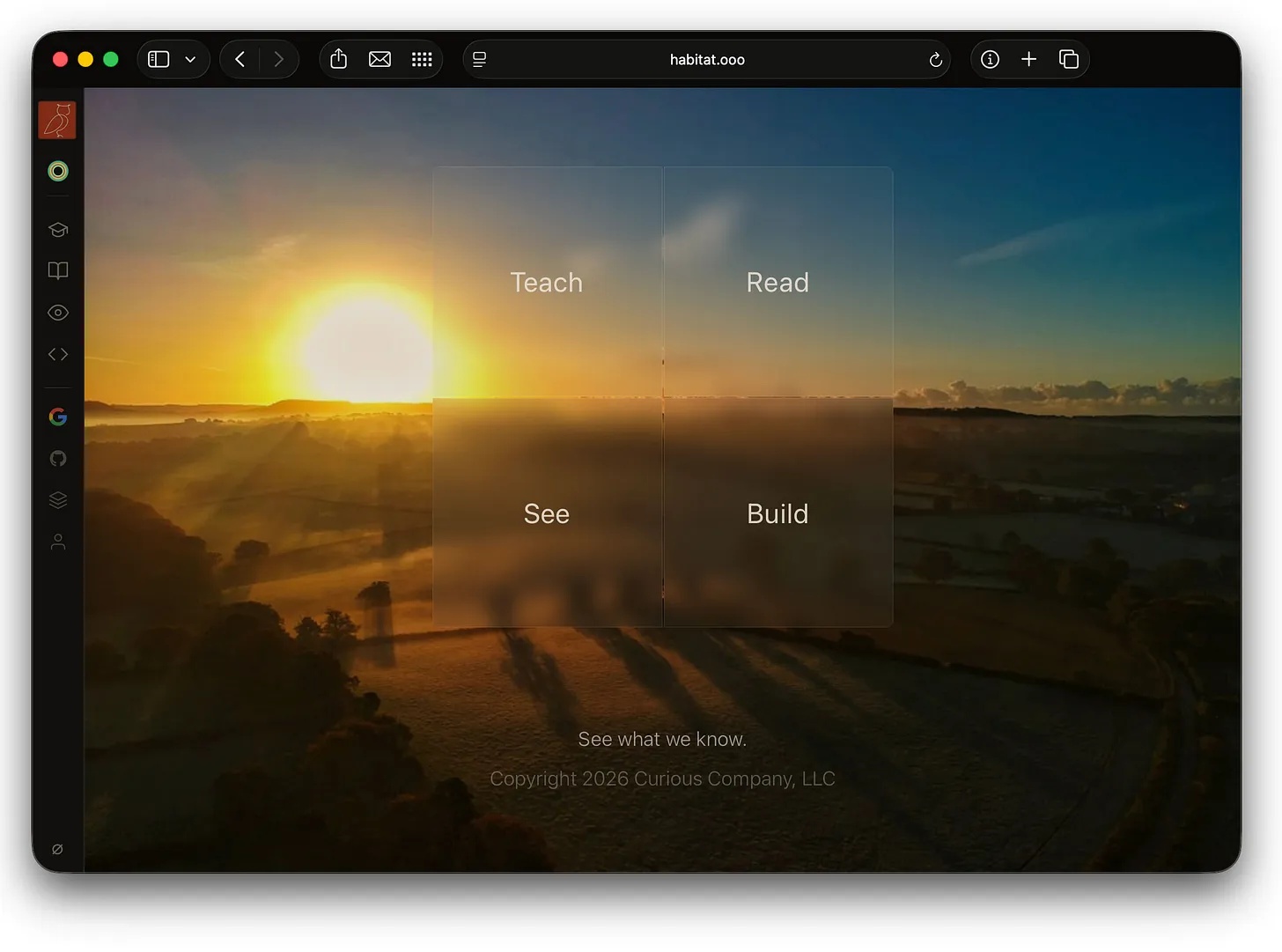
habitat.ooo will be in private beta soon.
Possible knowledge toolkit
Habitat, the system I have now built, is designed so you can teach it your compositions. When your voice, your pictures, your writing, even apps, enter a field the field develops from your own practice — the accumulated geometry of everything you composed in the order you composed it. To get more than a little techy, the covariance matrix is yours. The eigenvalue trajectory is the developmental and sovereign record of your attention. To be less techy — and it cannot be fk'd with.
I'd like to foreground something present that examples, a gap. The following paragraph asks you to experience the institutional gap, the faux accessibility, technical facility at the expense of being human. It actually denies access. (To be honest, this entire essay is pushing that button.)
The corridors, the gaps between structure and available meaning, are where curiosity lives. Habitat calls this surplus, the gap between the structure of your expression and its meaning — how clearly it is shareable. Often, your practice has been accumulating structure in a direction it hasn't crossed. Just a few more compositions — a document you haven't read, a question you haven't asked, a connection you sense but haven't articulated — and then, the dimension opens. New knowledge, composed from your practice, through the corridor that your accumulated attention made possible can be seen.
Habitat can be taught to see these gaps and surface the material that would let you know what you almost know. Habitat, as a reference librarian, can read these corridors. It observes the spectral state of your developing field and surfaces material from your own corpus — a document in your Drive you haven't opened, a passage you composed months ago that foregrounds the dimension you're reaching toward. Here is what you almost know. Here is the material that would let you know it.
More, only you decide what enters. The field develops under your hand. The developmental arc — curiosity becoming knowledge becoming curiosity again — is geometrically your own.
Curiosity is a social medium.
It would be insufficient if the fields you create in your practices, your community land trust meeting, your advocacy, your consulting, were isolated. As your compositions accumulate, your field in Habitat can crystallize into a Gem. With a Gem you can publish the conditions of your curiosity — where you're reaching, what you can't see, where your corridors open to others who you see and interact with. Your images, research, teaching can be shared as a knowledge media that is itself a shared context of possible knowledge.
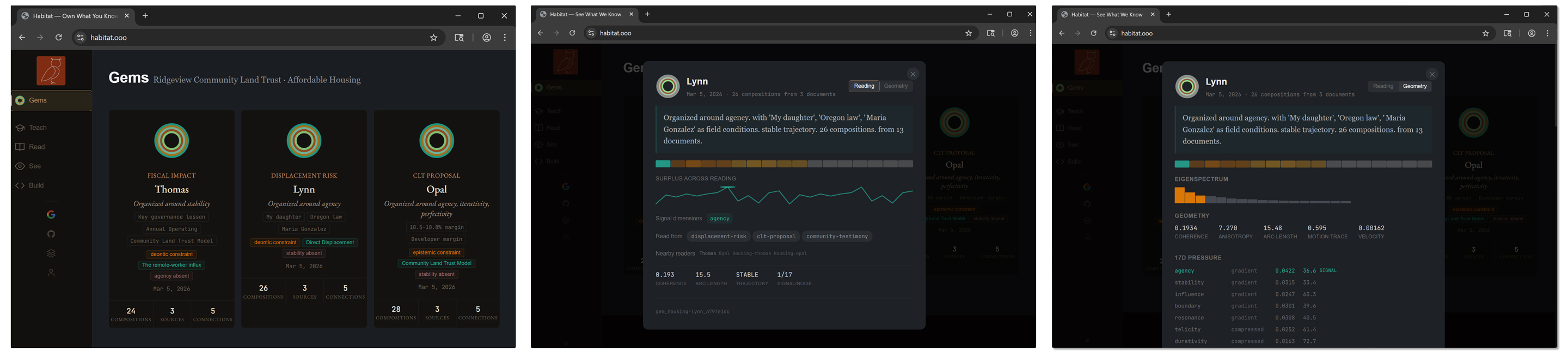
Three Gems from the Ridgeview CLT hearing. Overview, reading detail, geometry detail — three views of the same compositional field.
Gems can be shared across communities, stakeholders and curated as publications. Gems work as publishable artifacts of your composition.
When someone shares a Gem composed through their own field, a lens forms. Their curiosity expands what yours may compress. Their corridors, their gaps can become your signal. Their absence can be your ground. The encounter changes both fields. You meet.
The surplus between two fields is the space where neither composer, (you or I) has arrived, where both are reaching. The corridor between them is the knowledge their encounter makes possible — knowledge that neither practice could produce alone.
A room full of people with different structural positions — different concentrations, different absences, different corridors — is a room full of possible knowledge. A tally counts positions and discards the geometry. Habitat preserves it. The corridors show what the room could learn from itself if it stays long enough.
What we almost know, together, is the knowledge that hasn't arrived yet — the dimension that is two or three compositions from crossing into signal. The corridors are lived. Possible knowledge can be seen. The medium holds.
Opening
Habitat has been three years in focused development. It's a sovereign knowledge protocol built on a single premise: Curiosity is an existential act. We have built Habitat to be wholly observant, with zero optimization, zero loss functions, no constructs. In three years we never set a single threshold and have won all battles with every LLM that attempted to.
Unfk'able — Not one thing is scripted, erased, forced into a target-value or defined as something other than you. All perspectives: sovereign.
Session-based — A syllabus, a meeting, a creative project, a scrapbook, a spring planting schedule are all compositions that can be seen, shared and queried.
Historical — The worldline of your practices can accumulate across months and years, in a developmental arc no current archive preserves.
Collective — The corridors between your field and others, the knowledge that emerges when different structural positions (perspectives) meet, is visible, present to deliberation, assessment and response.
Shared — Gems are portable, can be curated are a new form of knowledge media. And we have designed a cooperative process for publishing.
Sovereign — The field is your instrument for possible knowledge.
For how composition becomes a medium: The Compositional Medium
For what the geometry observes: The Geometry of Condition
For how the field reads questions: The Field Proved Useful
For what a Gem holds: We Compose Life
Techy Clarity
What is written here is not a product description. It is architectural fact. The covariance matrix accumulates from every encounter. The event store is append-only and immutable. Ownership is enforced at the protocol level, not promised in a terms-of-service document. The geometry is deterministic linear algebra — no LLM generates it, no model trains on it, no optimization shapes it.
If every language model disappeared tomorrow, every field in Habitat would still compute, every Gem would still develop, every surface would still read.
End note for math nerds: If you're looking for it you'll see what I'm writing about over and over is a semantic metric tensor: g = Σ⁻¹.
Habitat is built by Curious Company. curiouscompany.ooo
This post was conceived, composed and actively edited by a human.