Observable, Social Knowledge
Curious · February 2026
Habitat Public Beta
Why Now
Knowledge has always been social. It forms in the act of reading closely, annotating, connecting one idea to another across time. In the image you return to, the passage you clip because something in it shifted. In the moment two people reading the same material discover they are seeing it differently.
The practice itself isn't visible. Language becomes representation — essays, arguments, credentials — and representation is what we reward, what we build institutions around. The practice that produced it gets buried, erased, homogenized into an output that becomes the whole frame.
Generation collapses this further. When a machine produces fluent text on any subject in seconds, representation detaches from practice entirely. The output looks like knowledge. But the discernment is gone, the ownership-genesis is gone, the record of how understanding developed through engagement is gone.
Knowledge is not the expression. It is not the condition. It is the condition of expression — the doing that shapes understanding over time. When that doing is observable, social knowledge becomes a living process that, when shared, celebrates both the act and the actor. Curiosity expands back into something you can share.
Habitat makes the doing visible.
What Habitat Is
Habitat is a compositional workspace. You read, you clip, you annotate. Every act of engagement is a composition. Each composition enters a geometric field that accumulates the shape of your practice over time.
This isn't tracking. It isn't analytics. It isn't logging what you clicked or how long you spent. It's observing the structure of what you attend to — which ideas you return to, where your thinking expands, where it settles, where it breaks through into something new.
The system does this through two independent representations of everything you compose: a compositional space derived from linguistics (what your language does — its agency, its temporal structure, its causal weight) and an embedding space (what your language means in context). The gap between these two is called surplus. Surplus is the primary signal. It's where learning is actually happening.
The mathematical foundations are described in detail in the companion papers: The Precision Matrix as Developmental Metric and The Geometry of Practice.
What You Do
You join a workspace. A workspace is a syllabus, a research project, a reading group — any sustained engagement with content. Each workspace has a reference field: the shared material everyone is working with.
You read. In the Read frame, you engage with source texts — clip the passages that matter to you, annotate them. Reading is the primary mode of the beta. The act of selecting what matters to you is itself a composition that enters the field and shapes the geometry.
You see. In the See frame, you curate images. Visual engagement produces compositions alongside your reading — your attention to images shapes the field too.
The field observes. From your first composition, the system begins producing observations. As your practice accumulates over days and weeks, dimensions that were open early on develop definition. The developmental portrait shows not just where you are, but the trajectory of how you got there.
What You Get
A living geometric portrait of your practice. Not a score. Not a badge. A shape — showing where your knowledge is dense and settled, where it's actively developing, where something just broke through, and where something new is possible.
This portrait accumulates across everything you do. It is stored as a portable file — a Gem — that you own. No institution controls it. It lives on your storage. It goes where you go.
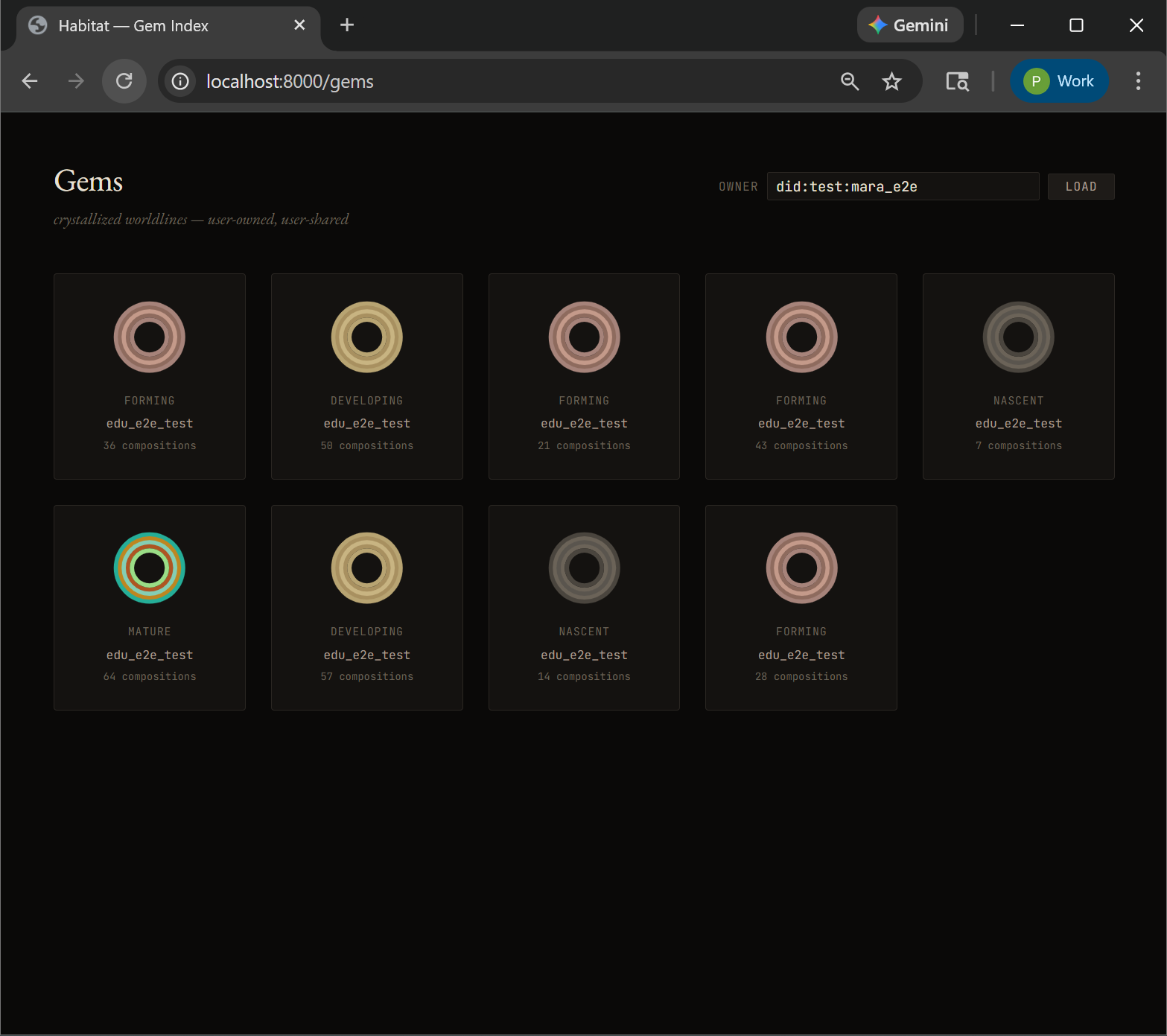
A user's Gem collection. Each icon shifts color as the field develops — muted tones for nascent sessions, vivid polychrome for mature ones. Every Gem is a frozen worldline through semantic spacetime.
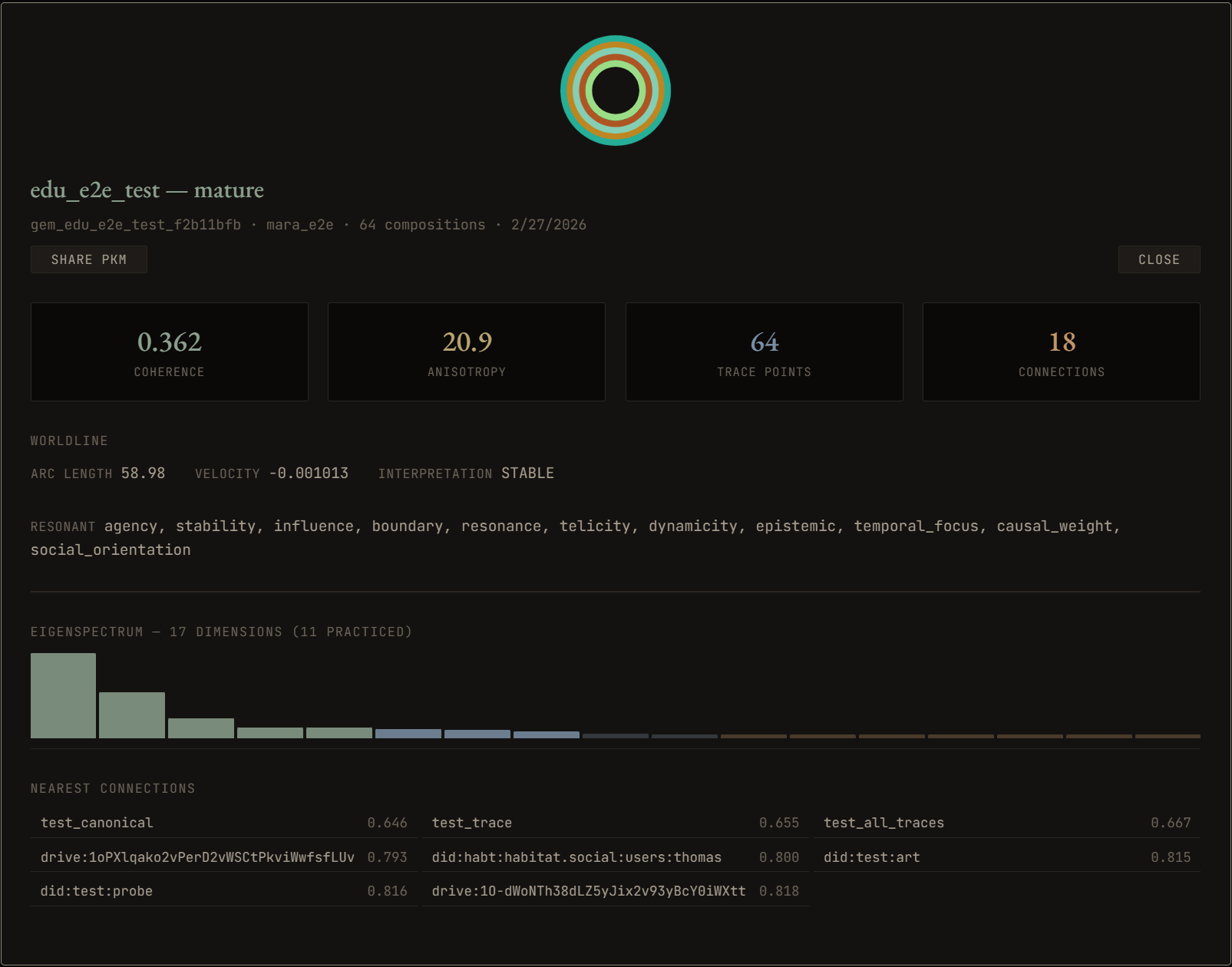
An expanded Gem. 64 compositions. Eleven resonant dimensions. The eigenspectrum shows where practice concentrated. The worldline says STABLE — the field found its shape and stopped moving. The geometry is visible to the person who produced it. Read more →
What Makes It Social
When you opt in to a shared workspace, your practice enters a collective field. The geometry of what you attend to enriches the geometry of what everyone attends to — with your consent, with provenance tracking, with your identity attached to your contributions.
Two people reading the same material will produce different geometries. Where their fields couple — where they see the same structures — is observable resonance. Where their fields diverge is observable difference: not disagreement in opinion, but difference in geometric structure. They are attending to the same material from genuinely different vantage points.
A classroom, a research group, a reading circle — any shared workspace becomes a collective field whose shape reflects the actual practice of its participants. Where is the group collectively dense? Where is it sparse? Where is there structural diversity that no one has noticed yet?
This is what social knowledge looks like when it's observable. Not a feed. Not a like count. Not a comment thread. The accumulated geometry of shared practice, visible to everyone who contributed to it.
Gems are portable between contexts. A Gem carries the shape of what you practiced — not a transcript, not a summary. When you move between courses, institutions, or careers, the Gem goes with you. When you share it, the recipient sees your developmental geometry directly.
What Changes for Teachers
You observe.
A classroom running on Habitat can be anywhere — a specific room, a school, an organization, a distributed group. A field is created by each participant. Each field shows that participant's relationships with the material: how they are forming, where practice concentrates, where it moves.
The classroom field shows the collective geometry. Where participants cluster. Where there is structural diversity. Participants whose fields couple asymmetrically are seeing the same material from genuinely different positions. That's observable intellectual diversity. Habitat makes this visible.
What's continually observable is how knowledge is forming — the conditions of expression as they develop. That changes what teaching can be.
What Changes for Learners
Participants own what they know.
Every composition — every clip, every annotation, every passage you select — enters your field and stays. The geometry only grows. Nothing is overwritten. Nothing expires. Your developmental trajectory is a permanent, portable record that no institution controls.
The more you practice, the more the geometry differentiates. Early compositions open dimensions — they allude to possibility. As practice accumulates, those dimensions develop shape, density, trajectory. Each one becomes a visible aspect of your knowledge. The geometry doesn't judge where you start. It observes where your practice takes you.
The Invitation
The system is live. The geometry is real. Read and See are open.
Crafting the private beta involves all of these things, with media from different practices, knowledges. We're on it. Stay tuned.
Join the beta: habitat.ooo Documentation: docs.habitat.ooo Research: zenodo.org/records/18732255
Curious Company LLC · Habitat Foundation All rights reserved. Patent pending.