Habitat Builds Sovereign AI Integration — Read, See, Build, Learn with Claude
March 3, 2026 — Curious Company
Today we built the infrastructure that makes Habitat a sovereignty layer between people and AI. We're testing it now in Private Beta.
Any person, group, community, organization, or business will be able to use Habitat to build coherent, living, sovereign knowledge. Anyone can Read, See, Build, Learn — and own what they know.
What we built
Habitat is a registered MCP (Model Context Protocol) connector for Claude. When you connect Habitat in your Claude settings, Claude gains 20 typed tools that talk directly to your semantic field — the living geometry of everything you've read, written, clipped, and composed.
But here's what matters: you control exactly how Claude participates.
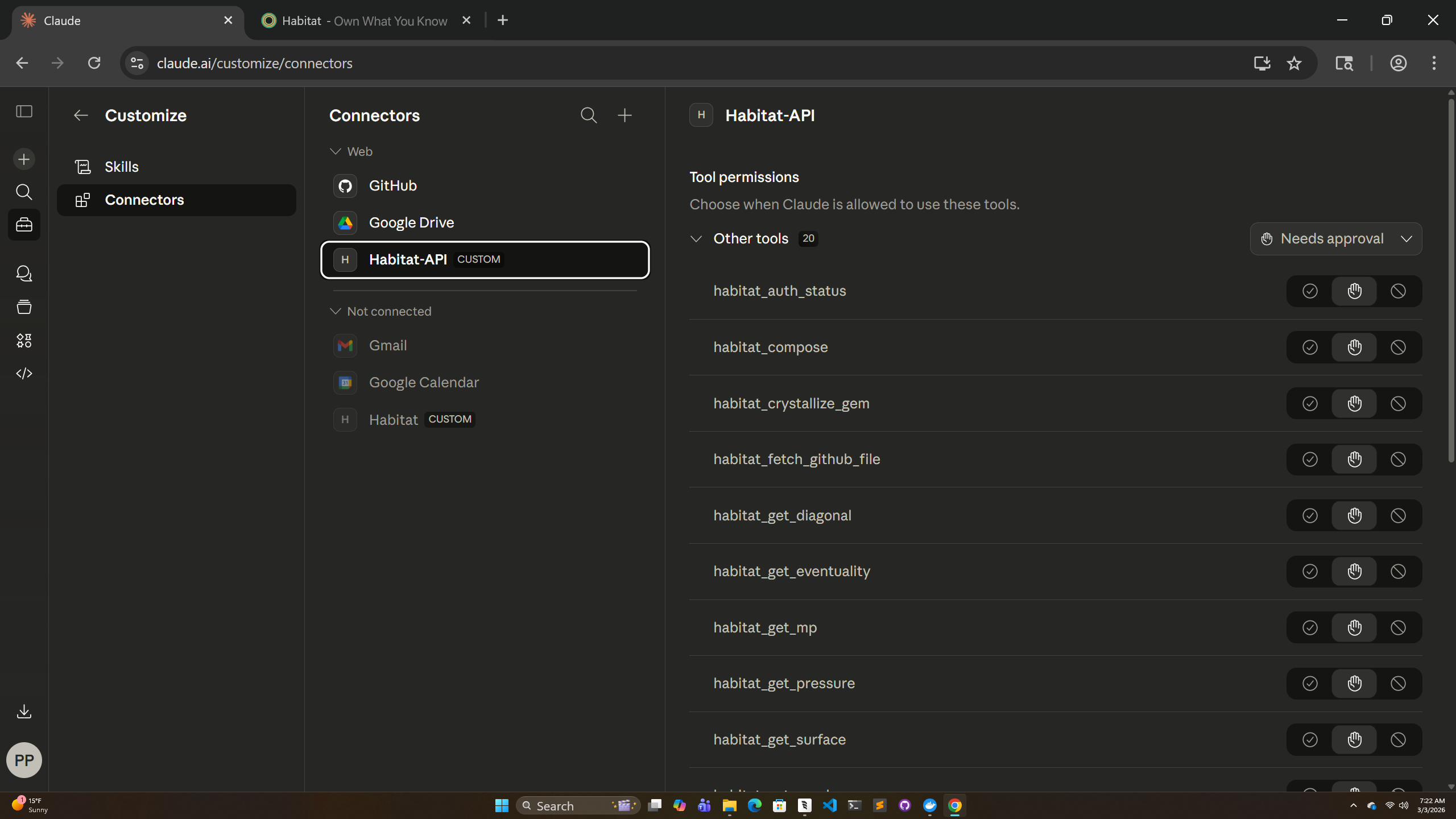 Claude.ai → Connectors → Habitat-API. Twenty tools. Per-tool permissions. Your field, your rules.
Three sovereignty levels
Sovereign (default) — Claude reads your field geodesically. It can observe your overlay surface, query your compositions, read per-dimension trajectories — but it never writes. Your field geometry is never modified by AI. This is the promise: your field, your geometry, your path.
Collaborative — You choose which tools Claude can use, per-tool. Enable ingestion but not composition. Allow gem crystallization but not self-reading. Every AI action is tagged with source_type: "agent_observation" in the append-only event store. Full provenance. Full audit trail. You can always see what's yours and what Claude contributed.
Full Integration — All tools enabled. Designed for onboarding, managed curation, and organizations that want Claude as a full field participant. Sovereignty is delegated, not surrendered — any user can downgrade at any time.
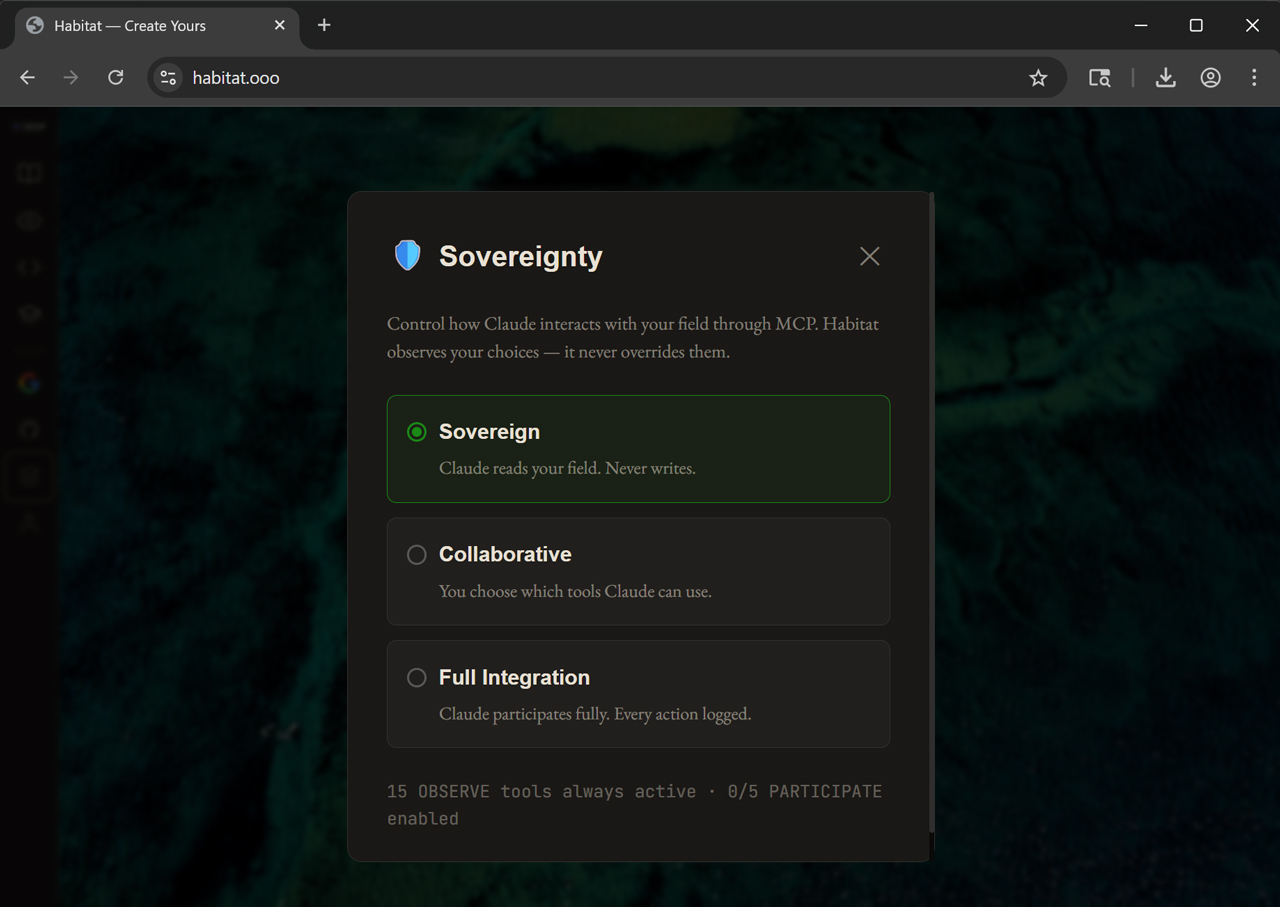 habitat.ooo → Sovereignty. Three levels. 15 OBSERVE tools always active. PARTICIPATE tools gated by your choice.
How it works
Sovereignty is enforced at the protocol level, not in a terms-of-service document.
When Claude connects to your Habitat, it asks the server: "What tools do I have?" The server reads your sovereignty settings and returns only the tools you've allowed. Claude literally cannot see or call tools you haven't enabled. If your settings change, the tool list changes. This isn't a preference — it's an architectural boundary.
Every composition in Habitat's field carries its provenance: who created it, when, what type (human, agent_observation, self_reading), and what context prompted it. The event store is append-only and immutable. Nothing is overwritten. Nothing is hidden.
What this means for Read, See, Build, Learn
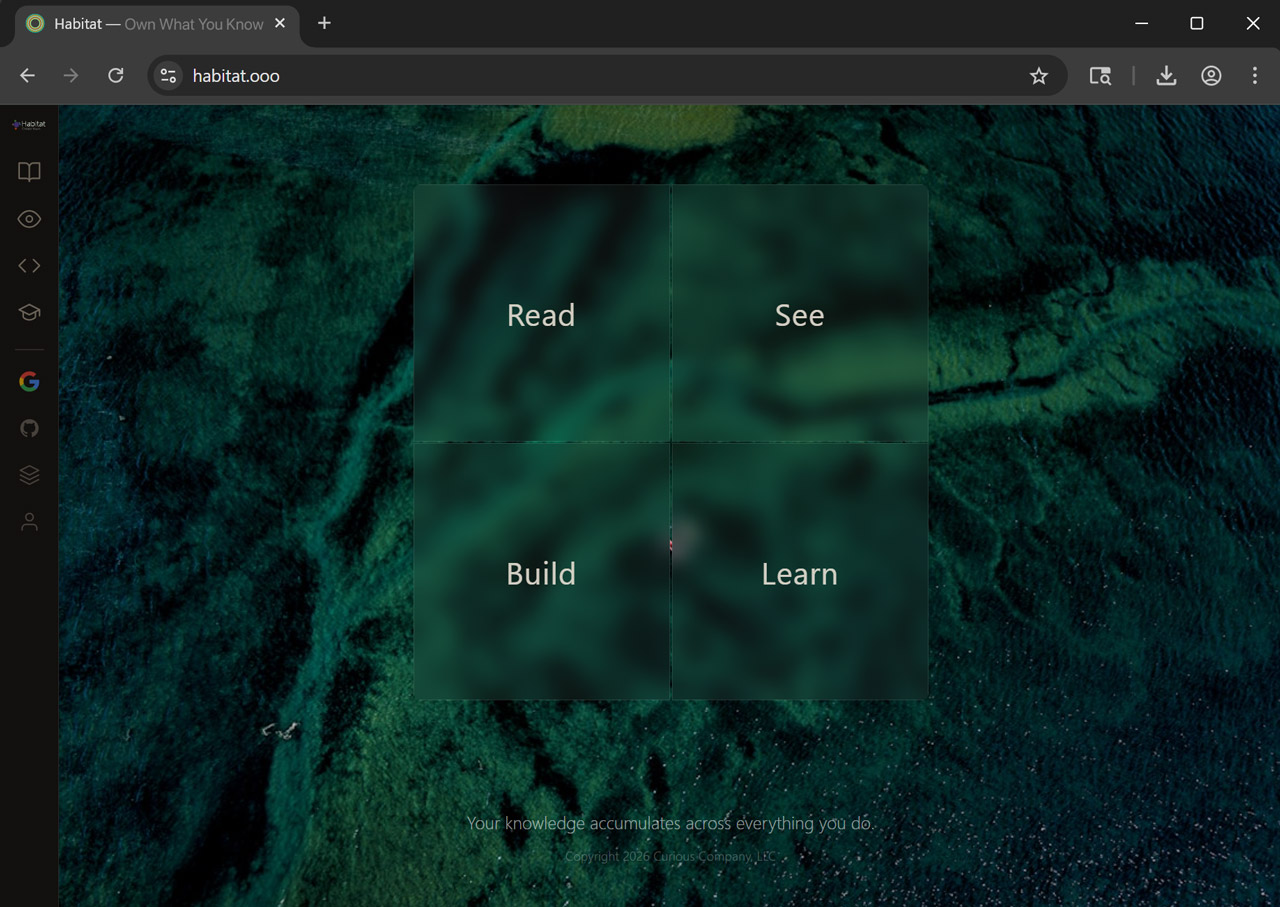 habitat.ooo — Read, See, Build, Learn. Your knowledge accumulates across everything you do.
Read — Open a document from Google Drive. Clip a passage. Claude reads the field's response geodesically — what emerged from your reading, not what a language model thinks you should hear. Your clips and annotations are your compositions, stored under your DID.
See — Images and gems become visible geometry. Gems are portable artifacts (npz files) that carry frozen covariance matrices, worldline traces, and overlay snapshots. They're sovereign — you can share them, publish them through The Label, or keep them private.
Build — Developers use Claude Code with Habitat's stdio MCP. Everyone else uses Claude.ai with the HTTP connector. The same 20 tools, the same field, the same sovereignty. Code enters as compositions, geometry emerges, Claude reads from it.
Learn — The field reads its own eigenspectrum. Self-reading measures how faithfully the field's geometry can describe itself. Eventuality classification shows whether each dimension is stable, moving, achieving, or accomplished. The curriculum is the geometry.
For communities
Habitat isn't just personal. Multiple perspectives couple through diagonal lenses. Communities share gems through The Label — a publishing model for knowledge media where coherence, participants, and cross-composition depth matter more than metadata.
The sovereignty layer means each participant controls their boundary while still participating in shared geometry. A community can set organizational defaults. Individual members can override. The architecture doesn't force a choice between privacy and participation — it holds both.
What's next
Once Habitat is live, you will be able to simply click the Claude icon in the sidebar. Choose your level. Toggle your tools.
Connection details will be shared with Private Beta participants.
Private Beta testing begins this month.
Habitat is built by Curious Company, LLC in partnership with The Commons Cooperative Company. The system runs on a dimensional compositional space. No loss functions. No optimization loops. The field preserves semantic content equivalent to field observation — through the entire pipeline.
Copyright 2026 Curious Company, LLC