Habitat — News
We Compose Life
Collective knowledge as a public resource.
March 6, 2026
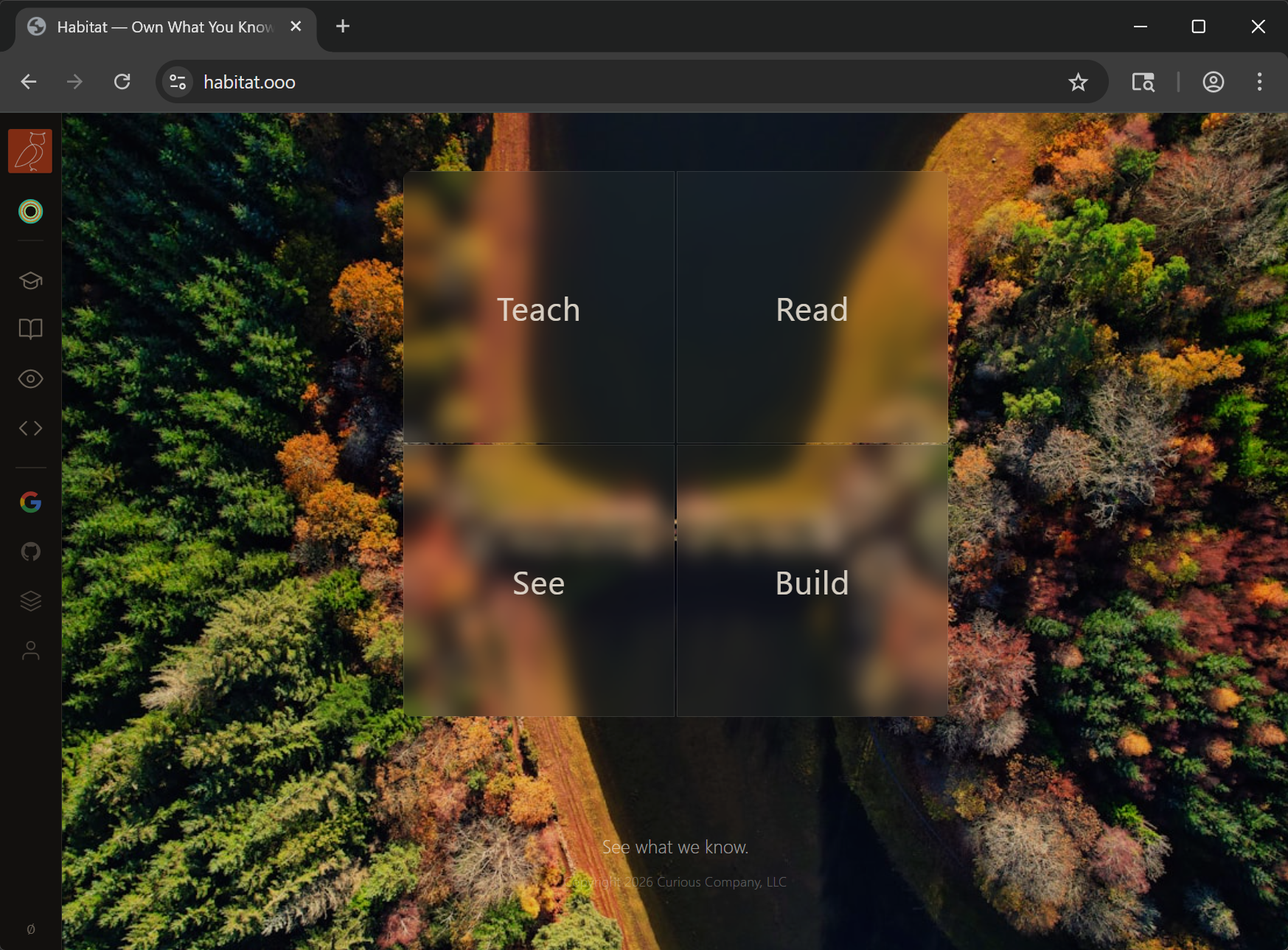
habitat.ooo
Everything we create has a shape.
The way we read (what we return to, what stops us, what we skip without knowing we skipped it) has a structure. The way we teach has a structure. The photographs we take of our garden across seasons, the drawings our children make of crystals on a windowsill, the notes a reporter keeps on sources who trust her. All of it accumulates into something with real geometric form. It has been accumulating our whole lives.
We've just never been able to see it.
This is the open secret. Our knowledge and curiosity have been measured, monetized, optimized, sold. They have never been made visible and actionable. It's a struggle just to see it. That is the grief we've been living with, whether or not we had a name for it.
Habitat returns it. Not as data. Not as a profile. As a field: geometric, observable, portable, sovereign. Yours to see. Yours to share. Yours to build on.
You access Habitat by composing into it.
A document you're reading. A photograph. A climate map. A source file. A child's drawing. Whatever enters your field changes its shape, because your attention changed shape in the encounter. There is no passive consumption. The architecture makes this structurally true: every encounter is a composition, every reader is an author.
Nothing is forced into a frame. The frame emerges from what you see and do.
Four engagements, not four options:
- Read: encounter through text. Write lives here. Every encounter is already a composition.
- See: encounter through images. Visual expression as practice, visual publishing as medium.
- Teach: compose with intent, sequence what enters, observe the geometry respond. Learn lives here. Learning is the observable change in the shape of your attention.
- Build: construct on the geometry. A workspace, a curriculum, a publication series. What practice reveals becomes what others stand on.
Each engagement performs the others. To Read is to compose, which is to Teach yourself something about what you attend to, which is to Build the field you'll See through tomorrow.
They aren't sequential. They elide. All four are a single motion: you access the field by composing into it. Not by requesting permission. Not by qualifying. The composition is the access.
And you give access to others. Habitat is a medium for publishing what you've composed. Gems of your knowledge, your work, your insights. Portable, accessible, and discoverable.
A "Gem" is a frozen moment of that geometry: a publication. When someone encounters your Gem, their field meets yours. Their field changes. The loop turns. Every encounter produces material for the next. The geometry shows you where you stand relative to someone else's field.
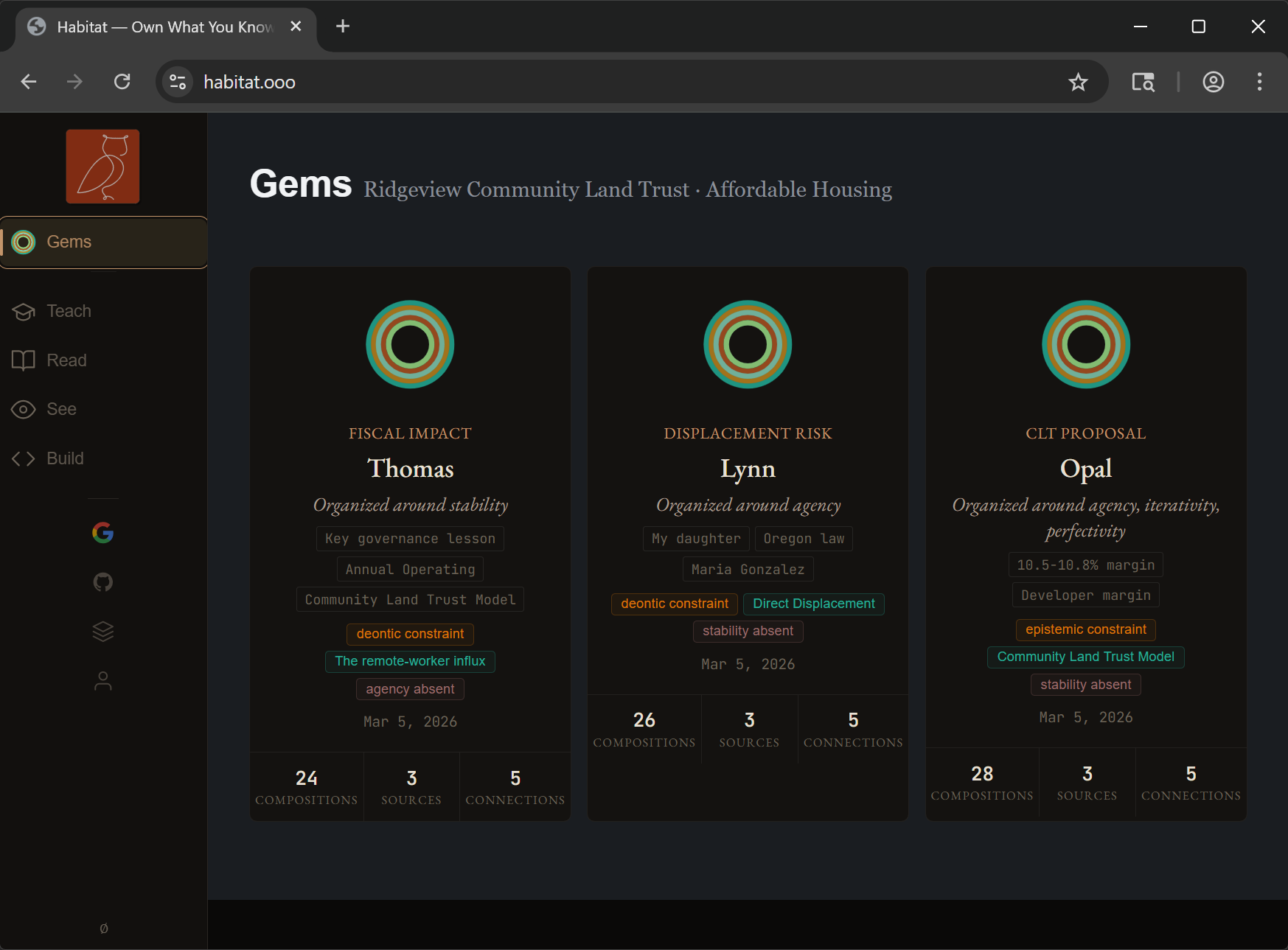
Three readers, three structural positions, one shared problem. What the tally discards, the geometry holds.
As an example: Who gets to live in Ridgeview? In a community land trust meeting, what's embedded, what's absent, what's conditional?
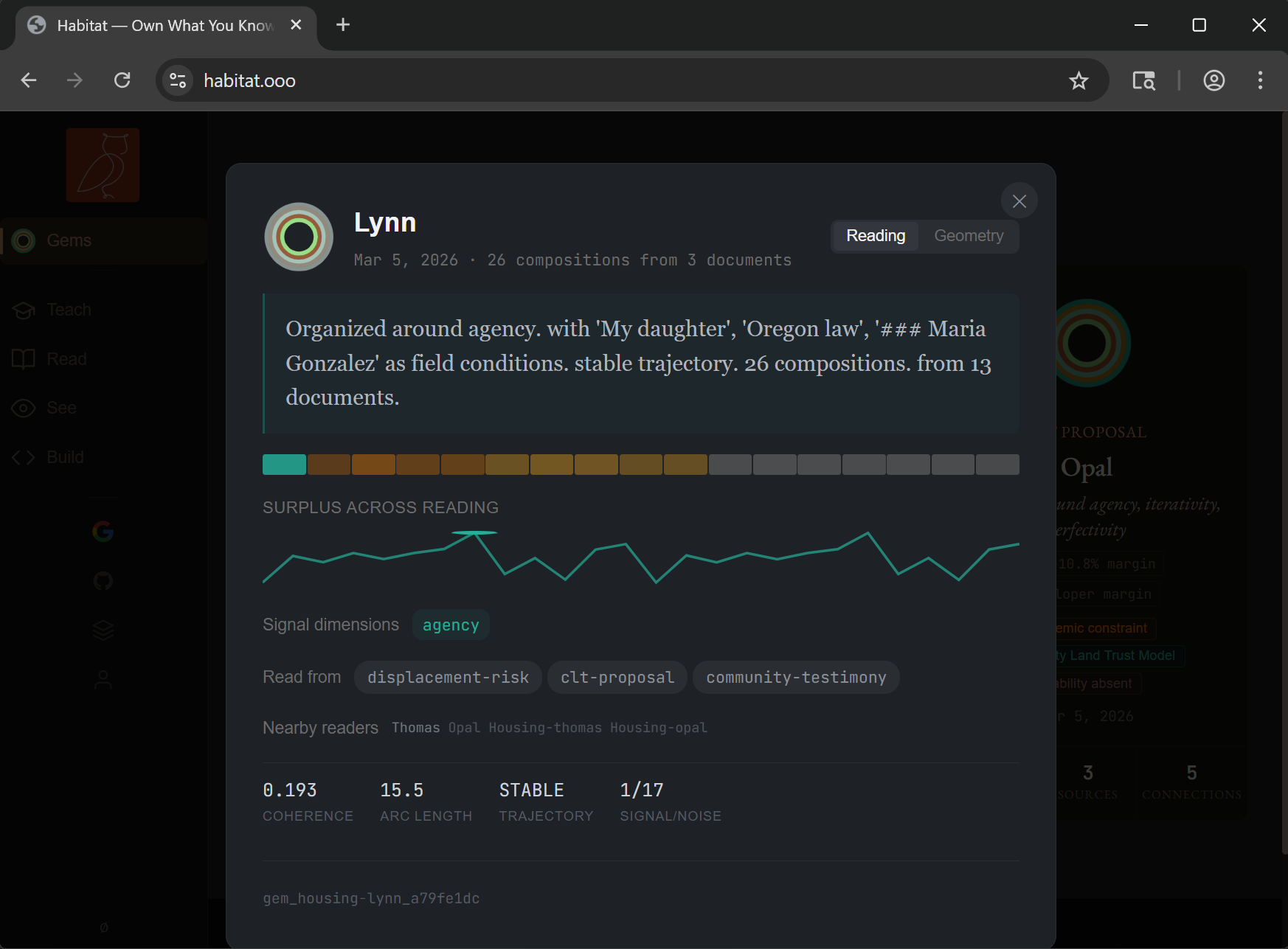
Lynn's Gem. Organized around agency. 26 compositions from 3 documents. Surplus across reading, signal dimensions, nearby readers. A frozen field.
In a Town Meeting, currently the most direct democracy we have, a tally (31 in support, 9 opposed, 7 conditional) discards the entire structure of what happened in the room.
Who could see what. Who couldn't. Where someone's lived experience exceeded the institutional grammar available to carry it. Where a developer's financial constraints narrowed attention to a single causal chain. Where the shared dimension was agency but the frames within it were incommensurable.
All of this was present. Legible to anyone in the room. And then it vanished, or was declared consensus, because no medium held it.
This is not a problem of data. It is a problem of medium. Habitat is this medium, a medium that geometrically holds what we know. "Pressure" shows where attention concentrates. "Surplus" shows where experience exceeds the available register. "Dimensional absence" shows what structural position excludes from view. The "negotiation surface" shows where mutual legibility is possible and where it isn't, and which direction the deficit runs.
What Habitat measures is publicly needed: the structural conditions under which communities do or do not make sense of themselves. That is what was lost when the tally replaced the room... everywhere.
What we as people do is not geometry. It is composition. We compose our lives. The access Habitat provides is not a promise, it's a condition: one where we can see the structure of our own deliberation.
Your field does not deplete the geometry available to anyone else. Your use does not diminish the resource. It requires stewardship: every Gem is sovereign to its creator, every field owned by its practitioner, the record append-only and immutable. The architecture enforces what the architecture promises.
And it grows through use. Each composition, each encounter, each Gem published and received enriches what the next person can draw on. Not because individuals compose in isolation. Because each turn produces material for the next.
A medium that gives people back the shape of their own attention, and lets communities see the structure of their own deliberation, is not a product. It is not a service. It is infrastructure a public can compose through. And in composing, can see.
We compose life as it composes us. What we practice has always had shape. Now it has sun on it.
Next: "The Geometry of Deliberation" — what happens when people stay in the room long enough for their attention to change shape?
Habitat is built by Curious Company. habitat.ooo
This post was conceived, composed and actively edited by a human.