Habitat Scenario 001 — Technical Proof Point
Three People Read About Housing. The System Watched How They Think.
March 3, 2026 — First multi-user document ingestion via Google Drive → Claude → Habitat
This is the technical companion to Who Gets to Live in Ridgeview? — the human-readable reading report. Start there for the story. Come here for how it was built.
What happened in under one hour
A city planner, a community resident, and a real estate developer each received documents about a proposed Community Land Trust in Ridgeview — a mid-size city where median home prices jumped 47% in six years while incomes grew 12%.
All three read the same ordinance proposal. Then each read two additional documents from their domain: the planner got fiscal impact analyses and comparable city studies; the resident got public hearing testimony and displacement risk assessments; the developer got market analyses and feasibility studies.
Seven documents. Three readers. One policy question.
The documents lived in Google Drive. Claude read them with the user's permission, then ingested each into Habitat's semantic field — once per reader, tagged to their identity. No one told the system what to look for. No one defined categories, trained a model, or set up a rubric.
The system observed.
What the system saw
Each reader developed a distinct geometric orientation to the same policy problem. Not different opinions — different shapes of attention.
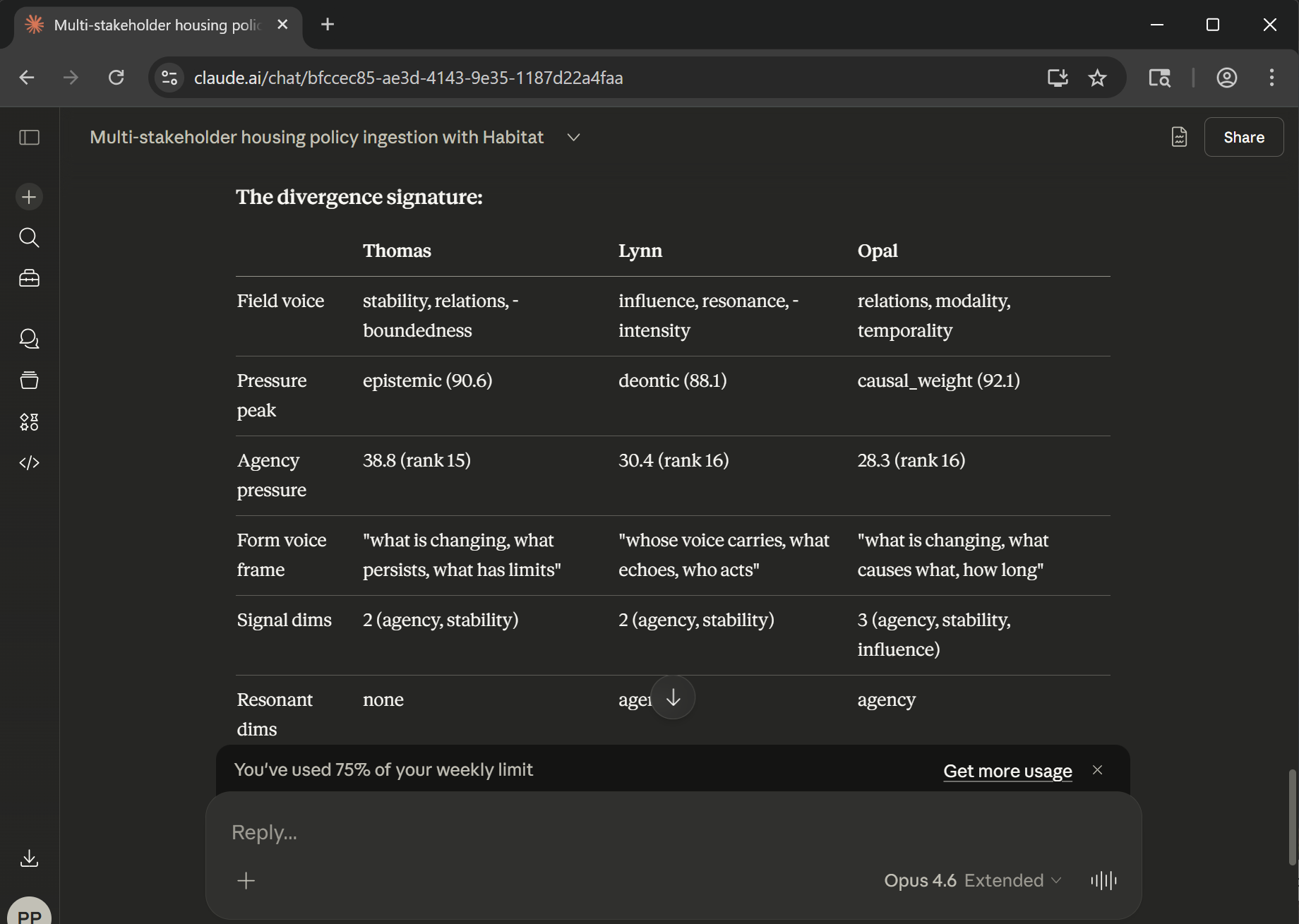 Claude.ai → The divergence signature. Field voice, pressure peaks, signal dimensions, and resonant dimensions for all three readers.
              Thomas (planner)    Lynn (resident)     Opal (developer)
              ─────────────────   ─────────────────   ─────────────────
Field voice   stability,          influence,          relations,
              relations,          resonance,          modality,
              -boundedness        -intensity          temporality

Pressure      epistemic (90.6)    deontic (88.1)      causal_weight (92.1)
peak

Signal dims   2 (agency,          2 (agency,          3 (agency,
              stability)          stability)          stability, influence)

Resonant      none                agency              agency
dims

ED lead       "Secondary          "displacement       "dual-income bidding
              Revenue Effects"    risk assessment"    structure"

Fidelity (α)  0.71                0.75                0.69
Thomas's field compressed hardest around epistemic certainty — what's true about the fiscal impact. His top compositions pulled from budget analyses, dedicated revenue streams, comparable city data. The field organized around what things cost and what institutional structures hold.
Lynn's field compressed hardest around deontic obligation — what's owed to the people who live here. Her top attended composition was a fragment from community testimony: "The community land trust proposal . is" — a sentence that carries no fiscal meaning but deformed the field geometry because it indexes who actually lives here. Her ED vocabulary surfaced "My daughter is a dental hygienist" — lived testimony with structural emergence of 0.352.
Opal's field compressed hardest around causal weight — what causes what in the market. Her top composition: "This analysis quantifies current supply-demand imbalance." The field was temporally oriented — when things changed, what drove what, how long cycles take. The ED vocabulary led with "The dual-income structure creates bidding environment" — a causal mechanism, not a person, not a budget line.
Agency was the loosest dimension across all three fields — the question of who can act is where the documents created the most variance. But the frame around that question was completely different: Thomas asked about institutional capacity, Lynn asked about community voice, Opal asked about market actors.
Same policy question. Three incommensurable epistemological orientations. Observed without forcing convergence.
How it works
The pipeline that produced these results:
1. Documents stay sovereign. The seven markdown files sat in the user's Google Drive — their storage, their control. Nothing was copied to a training set or fed to an optimizer.
2. Claude acts as intermediary. Claude.ai connected to Google Drive (native connector) and to Habitat (MCP protocol). It read each document with the user's permission, then called Habitat's ingest tool for each reader.
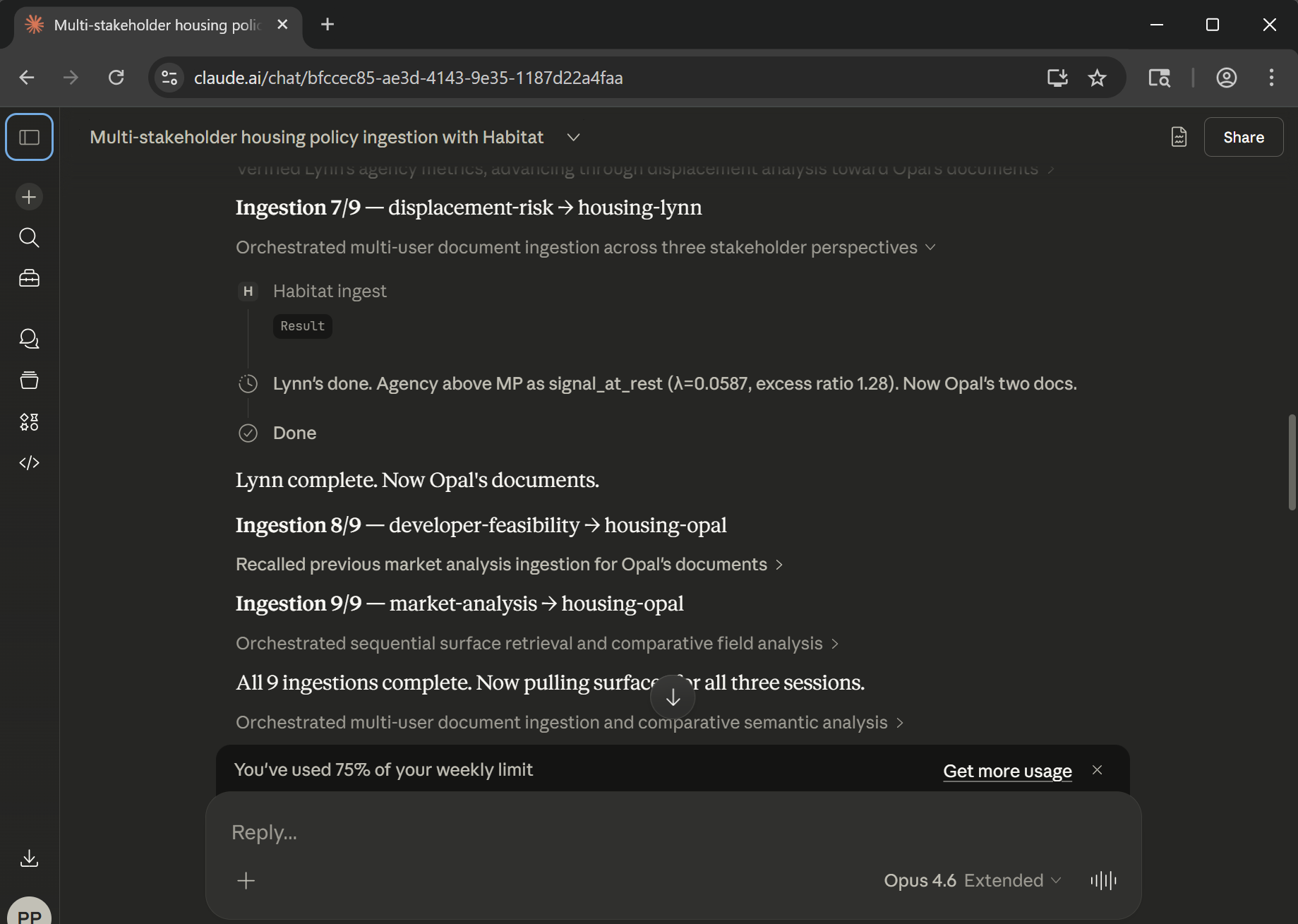 Claude.ai → Habitat ingest. Nine documents across three readers. Agency above MP as signal_at_rest. All ingestions complete.
Claude's ingestion calls:

  habitat_ingest
    session_id: "housing-thomas"
    user_did: "did:habitat:thomas"
    source_id: "clt-proposal"
    text: [full document content]
    source_type: "document"

  ... repeated 9 times (shared doc ×3 users + 2 per-user docs ×3)
3. Habitat builds geometry, not summaries. Each document enters a 17-dimensional compositional space (5D ProcessActor ⊗ 12D ProcessAssert) and a 768-dimensional embedding space. The system computes covariance matrices (Σ) per session, applies Marchenko-Pastur to separate signal from noise, and tracks eigenvalue trajectories through an append-only event store.
Thomas surface (after 3 documents):

  Field maturity: building (3 compositions above MP threshold)
  Signal dimensions: agency_capacity, stability_measure
  MP threshold (λ+): 0.0459
  Agency eigenvalue: 0.0587, excess ratio 1.28
  Pressure peak: epistemic_certainty (90.6)
  Eventuality: agency = signal_at_rest, stability = signal_at_rest
Lynn surface (after 3 documents):

  Field maturity: building (2 compositions above MP threshold)
  Signal dimensions: agency_capacity, stability_measure
  Agency eigenvalue: 0.0587, excess ratio 1.28
  Pressure peak: deontic (88.1), causal_weight (85.9)
  Resonant: agency (dynamic_factor 0.289)
  Eventuality: agency = signal_at_rest
Opal surface (after 3 documents):

  Field maturity: building (3 compositions above MP threshold)
  Signal dimensions: agency_capacity, stability_measure, influence_strength
  Pressure peak: causal_weight (92.1), abstract_level (91.4)
  Pressure ratio: 3.25 (tightest compression of all three)
  Resonant: agency
4. The sovereignty gate is real. Claude's access to mutation tools (ingest, compose) was blocked until the sovereignty level was explicitly set to collaborative. The system defaults to observe-only. The user's decision to open participation is recorded, auditable, and reversible. This isn't a permissions checkbox — it's architectural enforcement of consent.
What this means
Every existing collaboration tool — Google Docs, Slack, town halls, surveys — forces perspectives through a single channel. Comments are threaded. Votes are tallied. Summaries are written. The result is always the same: dimensionality reduction. The richness of how people actually orient to a problem gets flattened into agree/disagree, pro/con, thumbs up/thumbs down.
Habitat doesn't flatten. It observes that Thomas reads for fiscal certainty, Lynn reads for who's affected, and Opal reads for market causation — and it holds all three geometries simultaneously without ranking them. The convergence and divergence between these fields is itself observable: where do their covariance matrices align? Where do they diverge? What Fresnel zones concentrate shared attention, and where does surplus (the gap between compositional structure and embedding meaning) indicate that something is being said that the geometry can't yet hold?
These questions are answerable from the math. Not from sentiment analysis. Not from keyword extraction. From the actual geometric structure of how three people attended to the same problem.
What's next
The sessions are live on the deployed backend. The Habitat reader UI shows these documents and their social interactions. The convergence indicators in the social sidebar — diagonal lens comparisons between user pairs — will light up as readers engage with the same texts.
The next increments: a 17D heatmap showing where user pairs converge and diverge on click, cross-document stress maps showing surplus and Fresnel concentration across all three perspectives, and the self-reading loop — where the field reads its own eigenspectrum back into itself to measure how faithfully it can articulate what it observes.
The housing documents will stay in the system as a reference scenario. The pipeline — Drive to Claude to Habitat — works for any domain, any document set, any number of readers. The geometry is the interface.
The technology, briefly
What it is: A semantic observation system. Documents enter a 17-dimensional compositional space (derived from linguistic structure) and a 768-dimensional embedding space (derived from meaning). The system builds per-user covariance matrices, applies random matrix theory (Marchenko-Pastur) to separate signal from noise, and tracks how the field geometry evolves as documents accumulate. All data is append-only and immutable.
What it is not: A summarizer, a sentiment analyzer, a recommendation engine, or a search tool. There are no loss functions. No optimization targets. No training. The system observes geometric structure in natural language. It does not tell you what to think about what you read. It shows you the shape of how you're already thinking.
The integration surface: Google Workspace is the first connector. Any document source can feed the pipeline. The MCP (Model Context Protocol) means any AI assistant can connect — Claude today, others tomorrow. The sovereignty model ensures users control whether AI observes or participates. The system defaults to observe-only; participation requires explicit consent, enforced architecturally.
What's protected: The dimensional framework (Semantic Foam) is covered by provisional patent. The compositional algebra, the field observation protocol, and the geometric attention model are proprietary. The integration patterns and the MCP transport are open — anyone can connect. What they connect to is what's new.
As a Gem
This scenario — the three sessions, the seven documents, the field surfaces, the divergence signatures — is a crystallizable artifact. A Gem in Habitat's system is a frozen snapshot of field geometry: the covariance matrices, the worldline traces, the overlay surfaces, and the reading report that makes them legible. Gems are sovereign (owned by their creators), portable (shareable as self-contained archives), and composable (they can enter other fields as documents themselves).
Habitat Scenario 001 is the first Gem. The reading report is the face. This document is the spine. Future scenarios — different domains, different stakeholders, different scales — will join it on the Habitat dashboard, each carrying its own geometric signature.
Habitat is built by Curious Company. The semantic infrastructure is covered by provisional patent (Semantic Foam dimensional framework). habitat.ooo — Curious Company