 habitat
What Habitat reads, and how to check it
Habitat provides a view onto how features in language, in relation to actors and actions and the assertions about those actions, are distributed, and where they do not move. It recomputes those readings exactly, from the stored clauses. This works on any corpus large enough to check. Across a region's climate discourse it can present which features surface and have presence, and which move less or not at all.
Where a feature does not move, Habitat does not say whether the writing is silent or the reading is blind to it. That question stays open, and it stays on the page.
What Habitat is looking at
An act is one clause. Somebody does something to something, in a particular way. Habitat breaks a document into acts and measures each act on seventeen features of language: who is acting, whether the doing sits in one person or is spread across several, whether the writing hedges or commands, how it marks time, where it draws a boundary.
A voice is a group of documents somebody declared. Town reports are one voice, community meeting records another. A person says which document belongs to which voice before the reading starts. Habitat never guesses, and the reading is of that decision as much as of the text.
What can you actually check?
A reading you cannot check is a reading you have to believe. So before any counts, here is the whole of what Habitat takes out of a single sentence, on one feature, in two real documents.
Below is one comb. Each upright mark is one statement a document makes, in the order it was written. The left half is a town's water supply strategy, the right half a salt marsh monitoring report, one passage of 60 statements from each. The height of a mark is how much an actor is doing in it: whether there is an actor at all, whether it is a person, whether it is acting or being acted upon, whether the action lands on anything.
Move across it and the sentence behind any mark appears underneath, as it stands in the document, with three things marked in it.
The water supply system in Gloucester is divided into two systems separated geographically by the Annisquam River, which flows northward through the middle of the City into Ipswich Bay.
Underlined is the thing doing. Not a subject word, the whole phrase, in Gloucester included.
Italic is what this clause asserts about it. Not a verb, the whole phrase.
Grey is a clause inside that clause. It is a second act with its own reading, so it is shown where it sits rather than folded into the first or deleted. The rest of the sentence stays on the page for the same reason: nothing is hidden from a reader who wants to disagree.
That is the whole of what Habitat takes from a sentence. Every mark on the comb is one of these, and every number anywhere else on this page is built out of them.
This is one feature and one passage. The same frame holds for any of the seventeen and any body of documents. What follows uses it at scale.
A reading of one region
Habitat read 27 documents from Cape Ann, a coastal region in Massachusetts. The documents are five voices on the same place. For each voice, on six of the features, it measured how much that voice moves against how much the whole corpus moves. Below are all thirty of those numbers.
Beside each number is the range you get when the voice labels are shuffled two hundred times, so the label means nothing. A number outside that range means the labels were carrying something. A number inside it means the reading is what any group of that size does.
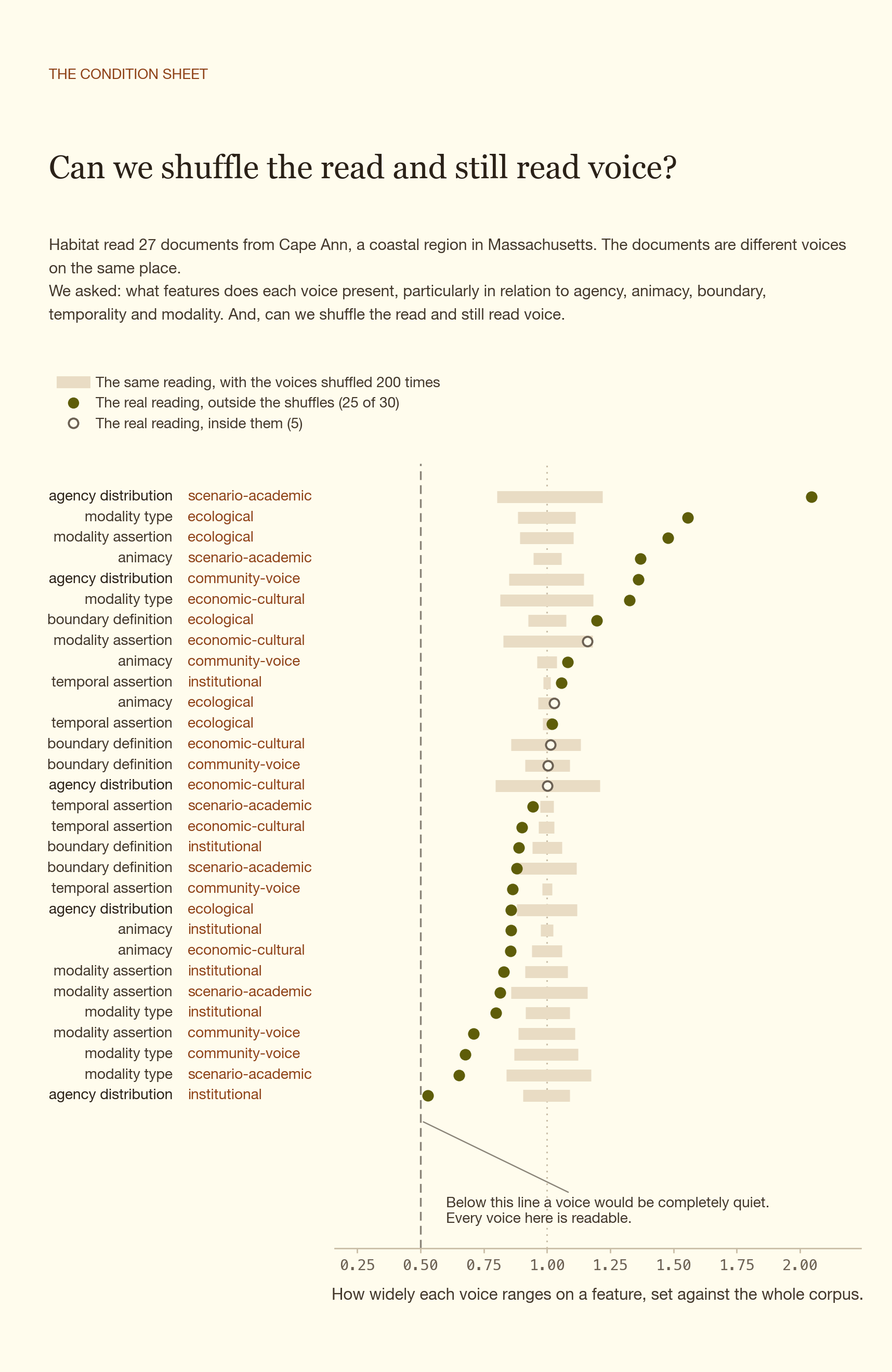
Agency distribution, whether one actor has agency or if it is spread across multiple actors, is most consistent in institutional writing. Institutional writing in this corpus has greater consistency, varying less than the overall corpus. Agency distribution is the most variable in scenario and academic writing, at twice the corpus. Community voices vary more than the overall corpus, economic and cultural writing sits level with it, and ecological writing just below. The meaning of this is left to the reader.
That paragraph is the reading. Habitat produced the numbers and the ranges. A person decided which documents were which voice, and a person decides what the differences are worth.
This chart shows movement, not presence. How much a voice varies on a feature is one measurement. Where that voice sits on the feature is another, and it takes its own chart.
What the shuffle holds
There are two ways to shuffle, and they do not give the same answer.
Documents hold together. The clauses in one report resemble each other. Scattering every document's clauses into one pile removes that, so almost any real document looks unlike the pile.
The other way keeps each document intact and shuffles only which voice it is filed under. Run that way, five of the thirty land outside their range rather than twenty-five.
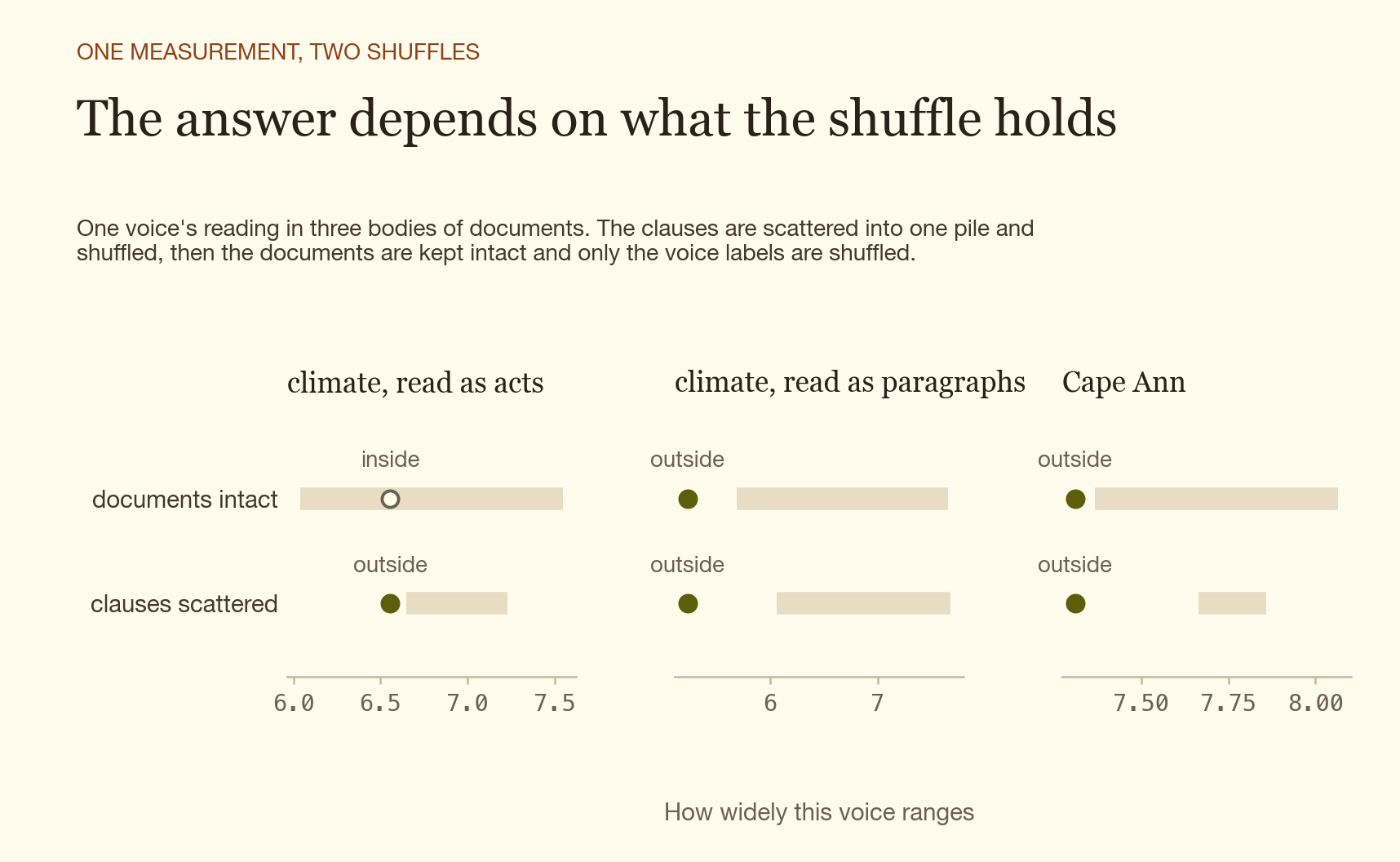
The rest of the condition sheet thins the same way. Of sixty measurements of who is acting and what is missing, forty-three land outside the range with the clauses scattered and six with the documents intact. Of ten measurements of how one voice's reading places another voice's clauses, eight and then one.
The measurements themselves did not move. Only the range around them did.
And the second range is not steady. The intake was corrected after this page first went up: the documents carry running page footers, and those were being read as text. Removing them changed the corpus by about a tenth of a per cent. Nothing in the first shuffle moved at all. In the second, all three counts did, in different directions: five instead of four, six instead of five, one instead of two. The reason is that the second shuffle has only twenty-seven documents to rearrange, so the range it produces is thin and shifts under almost anything. Wherever a number here rests on the second shuffle, treat it as approximate.
One caution runs the other way. Keeping documents intact means a voice made of two long documents is compared against groups averaging six, and a more varied group gives a wider range. Keeping documents intact may therefore be too severe for the voices built from fewest documents. Nobody has measured how much.
Two limits, stated plainly
A flat reading is not proof of silence. When a feature does not move for a voice, that may be the writing never doing that thing, or the instrument being unable to see it. Those two are not currently separable. The dashed line is the sharp case: the device built to call a feature quiet never fired once.
Small bodies of documents do not resolve. Below roughly a couple of thousand clauses the shuffles stop separating anything, and a single document has no check at all. The readings above rest on 20,695 clauses.
Why any of this is on the page
Every figure here recomputes from the stored clauses. Every check is a short script with its random seed and its files beside it. This page was published once saying the second shuffle had not been run. It has now been run, and it took most of the sheet's findings away.
A reading that can only be confirmed is worth less than one that could have been broken and was not.